What Is Local SEO? | A Complete Guide for Local Businesses

You probably don’t know much about local SEO, but you know that millions of people search for different types of businesses and services nearby, such as “dental near me,” “restoration in (city)” or “movers open now.”
Within seconds, Google shows them a list of local businesses, and they check their reviews and click on the most trustable ones.
Here’s what you didn’t know: the businesses that show up at the top aren’t necessarily the best ones in the area. But they’re the ones that did local SEO right.
So, what is local SEO, exactly? How does it work? And what does it take to take your place on the top search results?
We’re here to answer all of that. Read on and see how local SEO can help boost your business in a short time period.
What Is Local SEO?
To put it simply, local SEO is the process of optimizing your web presence so people nearby can easily find you when they need your services.
It’s much different from regular SEO because you’re not just reaching anyone online – you’re targeting the right people in the right location at the right moment.
Let’s say you’re a dentist. When someone in your city types “dental clinic near me” or “family dentist in (your city)” local SEO determines whether your clinic appears or gets buried.
Did you know that 46% of all Google searches have local intent? That’s nearly half of every search happening on Google every day, so you can’t ignore them.
Local SEO vs Traditional SEO
Both traditional SEO and local SEO are about ranking higher on Google, but they have different goals with different strategies.
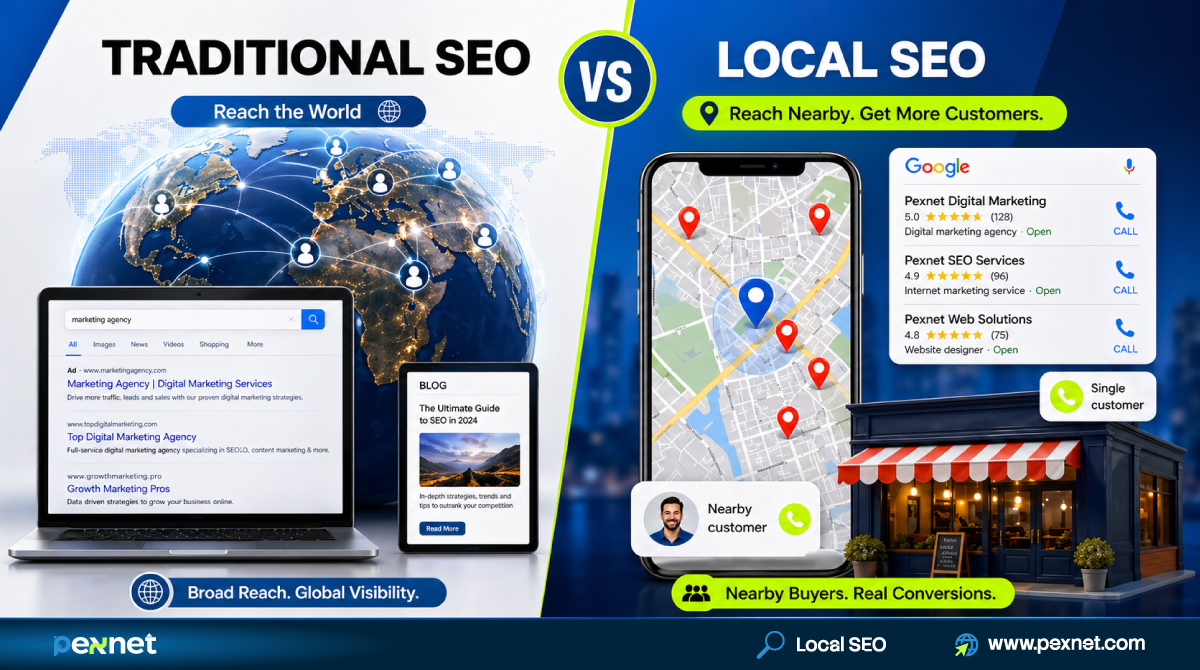
| Name | Traditional SEO | Local SEO |
| Target audience | Anyone, anywhere | People in a specific area |
| Search examples | “best dental care tips” | “dentist near me” or “dentist in Houston” |
| Ranking appears in | Organic blue links | Local Pack + organic results |
| Key ranking tools | Website content, backlinks | Google Business Profile, NAP citations, reviews |
| Best for | Blogs, ecommerce, national brands | Clinics, restaurants, service businesses |
As you can see, a dental clinic doesn’t need to rank nationally for “teeth whitening.” It just needs to rank locally for “teeth whitening in (city).”
How Google Decides Who Ranks Locally
Google uses 3 core factors to decide which businesses show up in local search results. You need to understand them to get the best returns from your local SEO strategy.
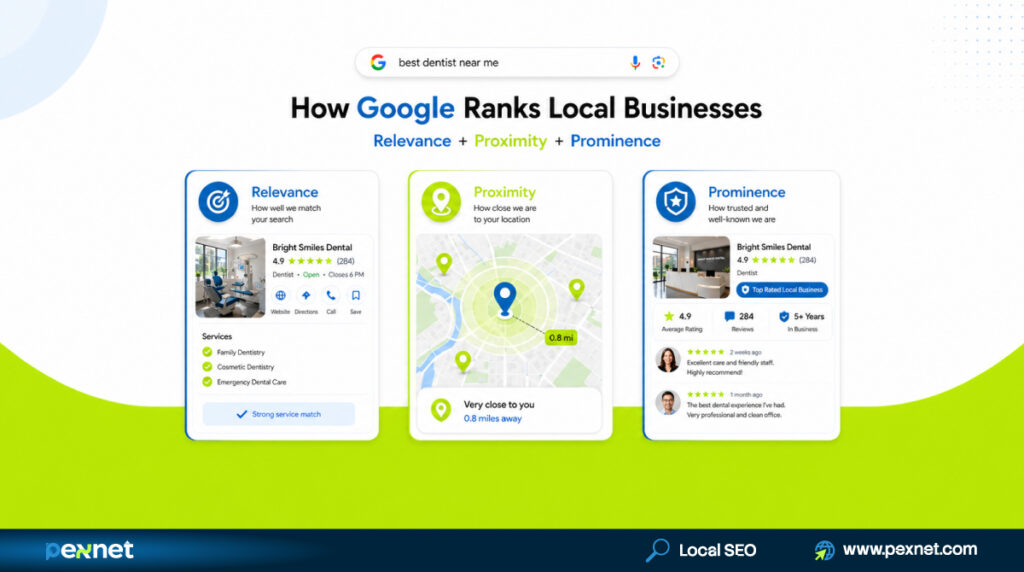
1. Relevance
Google checks how closely your service or practice matches what the person searched for.
If a patient Googles “pediatric dentist near me,” a general dental clinic with no mention of pediatric services on its GBP or website is less likely to rank than a clinic that clearly lists children’s dentistry as a specialty.
So, the more clearly you communicate what you do, the more relevant Google considers you.
2. Proximity
Google looks at how close your business is to the person searching. A dental clinic two miles from the searcher will outrank one that’s twenty miles away, even if they have the same local presence.
In fact, proximity is why “dentist near me” searches are so valuable. Google determines “near me” based on the searcher’s real-time location, not a city they type in.
3. Prominence
Prominence measures how well-known and trusted your business is online. Google usually looks at:
- The quantity and quality of your Google reviews
- How many authoritative websites mention or link to your business
- How complete and active your Google Business Profile is
- Your overall online reputation on different directories and platforms
So, a dental clinic with 200 five-star reviews, a fully completed GBP, and consistent listings across directories is much more trustworthy than a clinic with just 10 reviews and a half-finished profile.
Two Places to Show Up on Google’s Local Searches
When someone searches for a local business, Google shows results in two different ways. That means you should try to rank in both to give your dental clinic the strongest possible visibility.
1. The Local Pack (Map Pack)
This is a block of three business listings that appears at the top, usually alongside a map. It pulls directly from Google Business Profiles.
According to Backlinko, 42% of searchers click a result inside the local pack for local queries. You’ve to be there to get a significant share of clicks before anyone even reaches the organic results below.
2. Organic Results
Below the local pack, you’ll find the regular blue-link organic results. They are website pages, not GBP listings. Google ranks them based on their content quality, website authority, backlinks, and other on-page SEO signals.
So, the rule is simple: you’ve got to show up both in the local pack and in the organic results to dominate the page. If patients see your clinic twice, they might immediately trust you more than others.
Why Local SEO Beats Paid Ads Over Time
Yes, paid ads (Google Ads) can put your dental clinic at the top of search results starting today. But the moment your budget runs out, you’ll disappear.
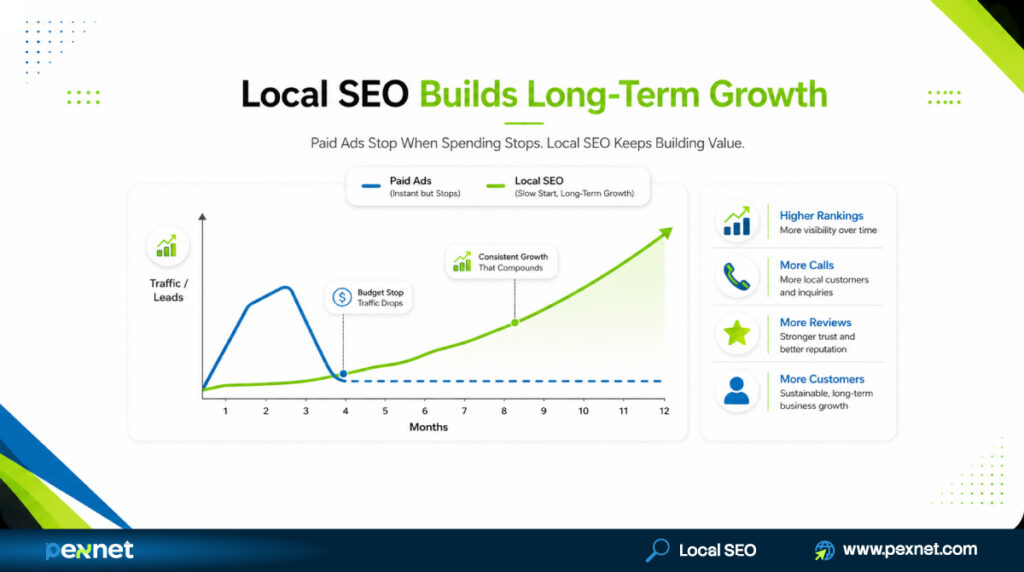
However, local SEO works differently. The visibility you build will keep compounding over time.
Here’s how it works:
When your dental clinic optimizes its website and GBP, builds citations, earns reviews, and publishes local content regularly, it will start climbing in rankings gradually. As rankings improve, more patients will be calling and booking appointments.
That’s not the end. More calls and bookings will keep generating more reviews, which will help boost your rankings further. At some point, your clinic will be earning organic traffic every single day without paying per click.
Our SEOs have seen that at the 6-month mark, a well-optimized clinic starts seeing consistent leads. By 12 months, the difference becomes clear compared to a business relying only on paid ads.
We can’t deny the fact that paid ads have their place, especially for fast, short-term campaigns. But local SEO builds equity as a long-term patient acquisition strategy that paid ads cannot match.
5 Core Pillars of Local SEO
Local SEO is a combination of five interconnected elements that need special attention to see real results.
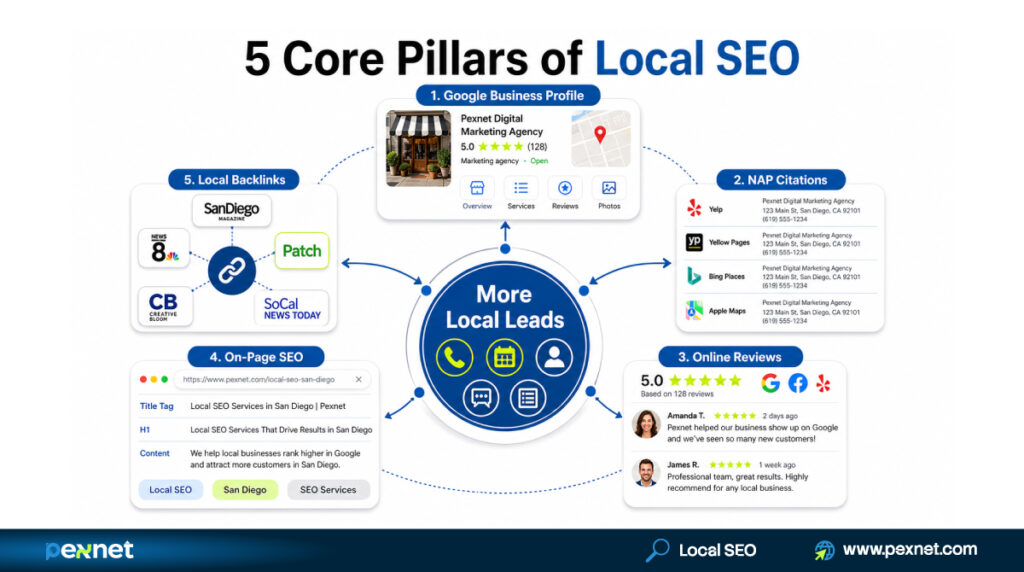
1. Google Business Profile (GBP)
If your GBP is fully completed and optimized with the right categories, photos, service descriptions, and hours, you’ll have a much higher chance of achieving local pack rankings.
According to Google, customers are 70% more likely to visit and 50% more likely to consider purchasing from a business with a complete profile.
2. NAP Citations
NAP stands for Name, Address, and Phone Number. And citations are mentions of your NAP on directories like Yelp, Healthgrades, and Zocdoc. Google’s algorithm cross-references these sources to verify your business is legitimate.
If your dental clinic is listed as “Bright Smiles Dental” on one directory and “Bright Smiles Dental Care” on another, it would mean trouble for your business because Google will be confused about this inconsistency.
3. Online Reviews
Reviews are super important because they directly influence both your local pack ranking and your conversion rate. So, never forget to request a Google review after a successful appointment.
Also, reply to negative reviews politely and thank them for their feedback. Acknowledge the issue without arguing, show that you care about the experience, and offer to fix the problem.
You can even share a phone number or email and invite the person to continue the conversation offline.
4. On-Page SEO
Google should know exactly where you are and what you do. For that purpose, you’ve to include your city and services in page titles, meta descriptions, headers, and content.
Also, create a dedicated page for every core practice, such as “teeth whitening in (city)” or “Invisalign in (city)”.
5. Backlinks
Good backlinks are links from other highly credible and relevant websites pointing to yours, and vice versa.
To be more specific, for a dental clinic, that means getting links from a city business directory, a local news article featuring your practice, or a dental association listing.
The more trusted local sources link to you, the more authority Google assigns to your website.
Local SEO for Service-Area Businesses
Not every dental clinic relies on patients walking through the door from the street. Many serve patients in a few zip codes, and some mobile dental services cover entire regions.
Google calls them Service-Area Businesses (SABs). These businesses serve customers at their location rather than having customers come to a fixed storefront.
Here’s what you need to know about SABs:
You can set a service area in your GBP instead of (or alongside) a physical address. Google uses this to determine which searches you’re eligible to appear for.
You don’t need a separate physical location for every area you serve. A dental clinic in downtown Atlanta can still appear in local searches on nearby neighborhoods by setting those areas as their service radius.
Also, don’t forget about creating dedicated location pages on your website.
A page targeting “dentist serving (neighborhood)” means you’re relevant for searches in that area, even if your office isn’t physically there. This is especially important for dental groups and multi-location practices.
In fact, each location needs its own fully optimized GBP, its own location page on the website, and consistent NAP details specific to that address.
How Patients Find You on Voice & AI Search Results
Our search behaviour has changed a lot lately. We’re now more specific, like “Hey Google, which dentist near me is open on Saturday?” Or, “Siri, find me an emergency dental clinic.”
Stats also agree, as 46% of voice search users look up local business information daily. Google pulls answers mainly from Google Business Profiles, structured data, and top-ranked local results.
Let’s talk about AI now. Google’s AI Overviews and popular AI tools like ChatGPT answer local queries directly pulling from verified business data, review scores, and website content.
All of this points to one direction – a local business with an incomplete GBP, inconsistent NAP data, or thin website content is far less likely to appear in these AI-generated answers.
To show up in voice and AI search results, your business needs:
- A fully completed and accurate Google Business Profile
- Consistent NAP data on all directories
- FAQ-style content on your website answering common questions (e.g., “Do you accept same-day appointments?” or “Are you open on weekends?”)
- Strong reviews with detailed text that mentions your services and location(s)
Remember, voice and AI search aren’t replacing local SEO, they’re extending it. Get the fundamentals right, and you’ll be fine tomorrow.
How Long Does Local SEO Take?
Here’s a practical timeline to give you some idea:
Months 1-3: Foundation Phase
The groundwork gets built in this stage. GBP gets fully optimized. NAP citations get cleaned up and distributed. The website gets updated with location-specific content.
You won’t see dramatic ranking shifts yet, but Google starts building a clearer picture of your business and small movements begin.
Months 3-6: Growth Phase
Rankings start to move more noticeably. If your clinic is consistently collecting reviews and your GBP stays active, you’ll see increases in GBP views, calls, and website clicks.
For less competitive markets, you may already be showing up in the local pack for some keywords by month 4 or 5.
Months 6-12: Results Phase
This is when local SEO starts paying off. Most small businesses working with a focused strategy see significant ranking improvements and measurable lead increases within 6-9 months. By month 12, the compounding effect is real, rankings are holding, reviews are building, and organic traffic is consistent.
However, the timeline varies based on how competitive your market is, how established your website is, and how consistently the strategy is executed.
For instance, a mom-and-pop shop in a small town may rank in 90 days, while a small enterprise in a major metro will take longer because it’s competing against 50 other practices.
Wrapping It Up
Now that you know what local SEO is, you need a plan that’ll work only for your business. You can’t do it alone unless you’ve years of experience. After all, it’s not a one-time task or a quick trick.
At Pexnet, we specialize in local SEO for small businesses only. We work with dental clinics, law firms, moving companies, carpet cleaners, and restoration companies, and help them take their places on map packs.
You can consult with our seasoned SEOs, share your SEO goals, find what’s not working in your current plan, and how to get quality leads leveraging the power of local SEO.
FAQs
1. What is the Google Local Pack?
The Google Local Pack is the group of business listings that appears near the top of Google search results with a map. It usually shows three local businesses, their ratings, location, opening hours, and contact options.
2. What is the difference between local SEO and regular SEO?
You need general SEO when you’re trying to rank your website for a broad audience (such as nationally or internally). On the other hand, local SEO focuses on ranking your business in a specific city, neighborhood, or service area. It revolves around Google Business Profile, reviews, citations, and map visibility.
3. What are the main local SEO ranking factors?
The main local SEO ranking factors are relevance, proximity, and prominence. Relevance means how well your business matches the search, proximity refers to how close your business is to the searcher, and prominence is about how trusted and well-known your business appears online.
4. How long does local SEO take to show results?
Local SEO usually takes 3 to 6 months to show noticeable movement, depending on competition, website condition, Google Business Profile quality, reviews, and citation consistency. But you may have to wait longer (around 6 to 12 months) to see significant results.
5. Can local SEO help my business appear in voice and AI search?
Yes, of course. Voice search and AI search usually rely on clear business information, reviews, website content, and structured local data. You’ll do good if you’ve a complete Google Business Profile, consistent NAP details, FAQ content, and strong reviews .

Riadul Islam
Riad is a Senior SEO Consult who lives and breathes all things SEO. With 11 years of SEO experience under his belt, he’s now deeply involved in applying AI search technology and data science into niche-specific SEO. He’s an active member of top SEO forums to keep his strategic thinking, problem-solving, and creativity supercharged.