Local SEO for Dentists: Expert Guide with 10 Proven Steps
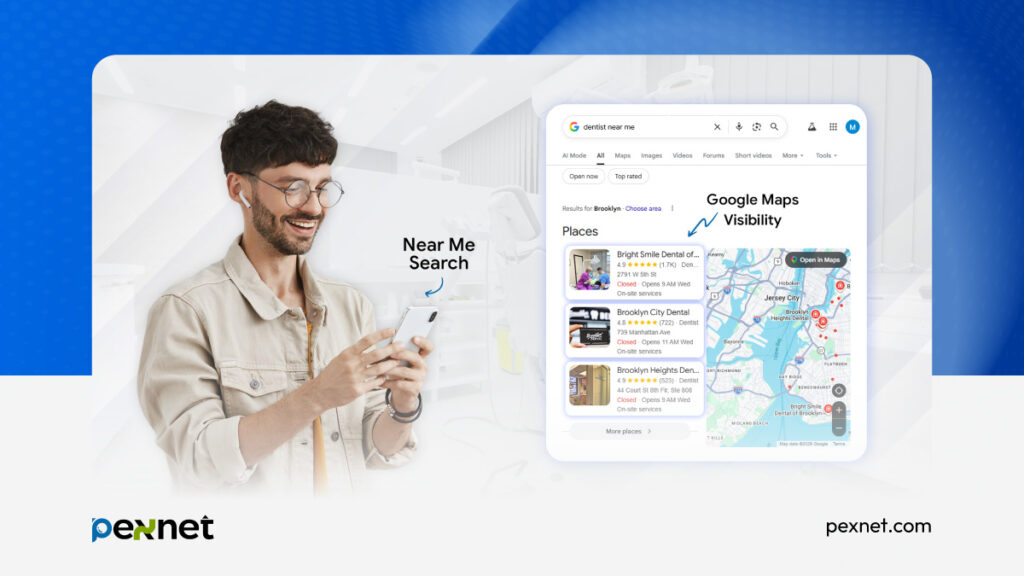
A patient with a severe toothache isn’t going to wait until the next day. They would simply search online, select a dentist, and book an appointment ASAP!
On the other side, despite providing value-for-money care, you are practically invisible. Reason: You are NOT in the top 3 of the Map Pack Results.
In 2026, people search online with an intent driven by trust signals and authenticity. The approach is more direct, local, and conversational at times. They would search for ‘dental clinics near me’, or ‘dental clinics best for toothache in City Name’.
This step-by-step guide to Local SEO for Dentists provides insights, processes, and execution guidance for local dental SEO that brings patients to your doorstep.
How Patients Search for Dentists Today (2026 Trends)
Inclusion of AI overviews, conversational searches, and voice queries has reshaped search trends. In 2026, patients seek cues of trust. So, they do these instead:
1. Voice Search and Conversational Queries
Speaks directly with the search engine in full sentences, often in a conversational tone. It’s more like asking someone for a dentist recommendation.
2. “Near Me” and Hyperlocal Intent
Searches with a defined intent, i.e., ‘dental clinics near me’. Problem-centric, or local searches, are also common, i.e., ‘ best dental service in Denver, Colorado for root canals’.
3. Mobile-First and Map-Based Searches
Uses their phone to search online. They also look for clinics that are closest to their location.
4. AI-Powered Search Behaviour
Seeks assistance from Artificial Intelligence or GPT models to get results within the search results (i.e., AI Overview). It aids in decision-making through fact-based answers, not a list of website links.
Even in the 2020s, the searching experience was not adaptive. People were restricted to rigid keywords. But now, searches are more defined and conversational. This revolution came because people have become better at identifying their true needs.

| Trivia: Almost 71% of the global searches on Google come from mobile devices. |
Benefits of Local SEO for Dental Practitioners
Dental Clinics operating without Local SEO support are practically a lost cause in 2026. With so many competitors vying for the top spot, mere word of mouth is simply not enough.
Local SEO strengthens your local relevance and brand image. It improves trust signals, allowing both search engines and patients to find you through localized search results.
Result: whenever people find you on top of the SERP, your phone will start ringing.
1. Increased Appointment Bookings
Practices like GBP optimization, local citations, review management, and more push your clinic’s Map Pack rankings. This results in greater visibility, thereby confirming more appointment bookings.
2. Higher Local Visibility and Trust
Mentioning your business in local and niche-specific directories, setting up the right service locations coverage on GBP, community involvement, and good reviews increase your dental clinic’s local visibility. So, people tend to trust you more.
3. Better ROI Compared to Paid Ads
Spending hundreds and thousands of dollars on Ads will simply get you rented leads. Stopping the spending leads to an abrupt halt in calls. But local SEO compounds over time, eventually creating a loyal patient base that brings in more every day.
4. Long-Term Patient Acquisition Strategy
People look for trust signals (good reviews, clear service information, hassle-free experience, local prominence, etc.) that ensure the quality of service. For that, they tend to be more loyal towards your clinic, which creates long-term relationships.
Local SEO creates a bridge of trust between the dentist and the patient. If implemented correctly, it can deliver quick wins and long-term recurring patients.
Sadly, most dentists and orthodontists miss out on such opportunities.
10 Proven Steps To Improve Dentist Local SEO Practices
Local SEO starts by fixing your local indicators. Features like GBP, Map Pack Rankings, Website, and Local content collectively elevate your relevance. Apart from that, dental clinics often fail to acknowledge building partnerships with local businesses.
To address these factors and integrate advanced practices, explore these 10 proven steps to improve your dental practice’s local presence.
Step 1 – Optimize Your Google Business Profile (GBP)
The first step is to work on your GBP. It serves as the primary trust signal for your clinic. Relevant information and trust cues help your GBP rank higher in the map pack.
If you are optimizing it for the first time, follow these steps carefully:
- Claim or create your GBP listing: Oftentimes, your profile might auto-generate for search relevance. In such cases, you must claim your account first. Otherwise, you can also create your profile with relevant business information.
- Complete verification: Google requires a detailed verification process that involves phone calls, video proofs, and documentation. Comply with these for quicker approval.
- Ensure the NAP is 100% accurate: Maintain a consistent name, address, and phone number across all platforms. Make sure that the information is accurate.
- Select Primary and Secondary Categories: Select ‘Dentist’ as the primary category. For maximum relevance, select multiple, relevant secondary categories that align with your practice.
- Write a keyword-rich, location-focused description: Make the description easy-to-understand, yet critically optimized. Include service locations, high-value keywords, and other trust signals for maximum relevance.
- Add all services: Simply adding services and procedures is not enough. Add local trust cues, such as ‘Root Canaling in Leander, TX’. Be specific about the service in each description.
- Upload high-quality images: Upload real, high-quality images of your clinic, staff, and day-to-day affairs. It serves as a strong indicator of the business’s authenticity.
- Add business hours, holiday hours: Make sure to properly add your service hours. Update frequently for weekends and public holidays.
- Enable messaging + appointment links: Use a smart messaging system to promote direct appointment leads.
- Add attributes: Mention additional benefits like wheelchair availability, special services, LGBTQIA+ compatibility, and more.
- Start posting weekly blog posts and updates: they’re ways to connect with consumers. Regularly posting with recent events, treatment procedures, and staff success stories can increase the lead flow.
GBP is closely entangled with your overall Google Maps Rankings. You will get higher results if your profile is highly relevant.

Step 2 – Master Google Maps Rankings (Local Pack SEO)
Maps rankings are all about proximity, relevance, and prominence. You should serve the local community, have a clear service description, and have a strong presence in the community.
- Ensure proximity relevance: You must add the right address and select the service area bandwidth. Optimizing location relevance to avoid useless traffic.
- Increase keyword relevance in GBP: Your service should provide accurate information, cater to the right audience, and deliver real-time results. Keep your profile updated through regular posts.
- Improve prominence: Your profile must include recent, verified reviews with real information. Also, create citations on local and dentistry-specific directories. You can also get direct brand mentions through guest posts.
- Encourage user actions: Design your map pack and GBP profile with relevant CTAs, such as clicks, calls, and directions requests. These should be easy to navigate.
- Add geo-tagged images regularly: Never update or add images without relevant alternative texts and geo-tags. These help you rank in image-based searches.
- Keep GBP active: Your GBP activities should be strategically active. Continuously update your Q/A, post regularly, and respond to reviews professionally.
- Monitor Map Pack rankings for target keywords: Regularly track their rankings. Identify and improve weak-performing keywords for better results.
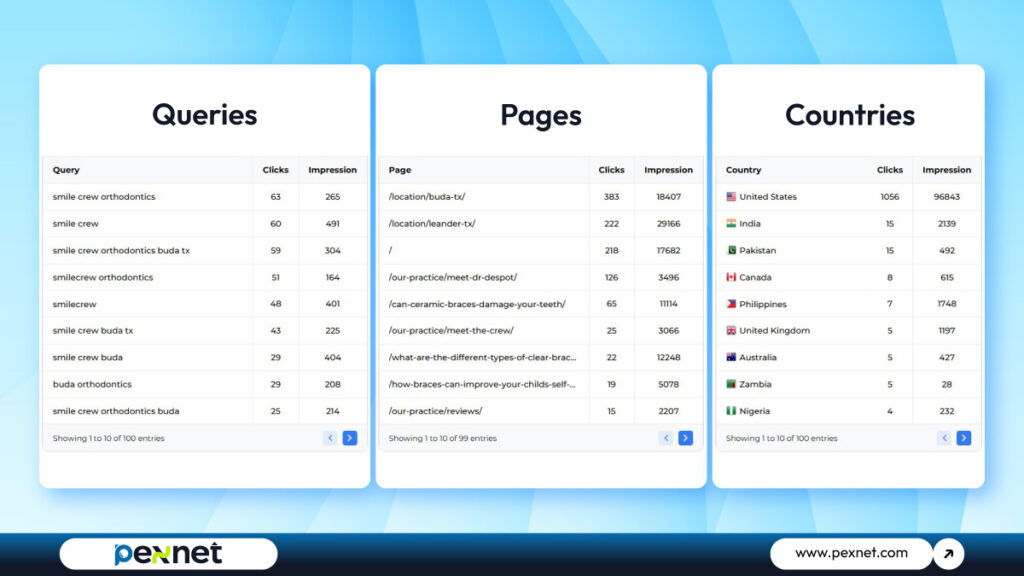
| What PexNet Did for SmileCrew Orthodontics, Leander, TX, in Google Map Pack and GBP:Claimed GBPOptimized Business Hours, inserted primary and secondary categoriesCreated and optimized the product sectionsUpdated GBP posts with updated Q/A, recent pictures, and common queriesReplied to reviews professionally. Result: See For Yourself! |
Step 3 – Perform Local Keyword Research (High-Intent Keywords)
If your proposal is not locally relevant, it will not cater to the right audience. For that, instead of using a generic approach, integrating local keywords, landmarks, and specific services makes your proposition stronger.
- Identify core services: Identify your core services. Core services include implants, whitening, orthodontics, emergency care, and more.
- Add geo modifiers: Specify which city you are situated in, which area you serve to bring healthier smiles, and which neighborhood you represent.
- Find “near me” variations: People now search with real intent. So, you must include keyword variations based on terms like ‘near me’, in [City Name], and more.
- Target long-tail queries: If you are relatively new in the industry, fighting for long-tail, low-competitive keywords would be a wise decision. Integrate smartly in your blogs and location-specific service pages.
- Extract keywords from competitors: Analyze your direct competitors who rank in the top 3 of the map pack. Examine what keywords they are integrating and plan accordingly.
- Google Autocomplete + People Also Ask: Find common queries your community is searching for. You can simply search on the search engines and go through the common queries from community platforms, such as Reddit and Quora.
- Group keywords by intent: Avoid meaningless, scattered keyword integrations. Instead, aim towards fulfilling the service intent or informational intent.
- Map keywords to pages: Your keyword hierarchy should clearly convey the essence of each page. Moreover, dedicated keywords should rightfully redirect you to their intended pages (homepage, service, pages, blogs, and more).
| How PexNet Excelled in Local Keyword Research for SmileCrewSee how effective local keyword research and integration bring traction for a dental clinic. |
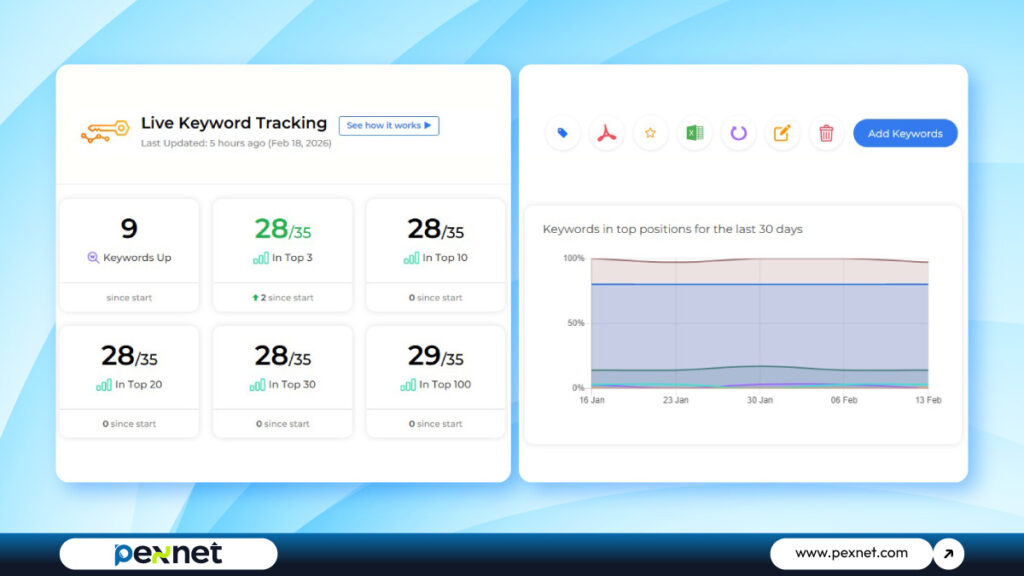
Speaking of webpages, your keyword integrations, map pack rankings, and local relevance will only work if you have a conversion-friendly website. Optimizing your website is the next step.
Step 4 – Optimize Your Dental Website for Local SEO
Dental websites are often left out in the cold. But very few know that websites are among the most important indicators of trust. Sadly, dentists and orthodontists often fail to optimize this primary asset.
- Optimize title tags and meta descriptions: They convey important information about your practice and what you offer your community. So, these should be direct, realistic, and in line with the intent. Use service-specific keywords and local relevance.
- Use clear H1 and H2 with local intent: A clear heading hierarchy should guide a patient towards a solution. Cater to patients’ local queries with expertise, and ensure that your content can fully convince them.
- Create dedicated service pages: Instead of clustering multiple services on a single page, create a high-value, high-intent service page for each service. Fulfill your service intent through effective trust signals.
- Add internal linking between related pages: Internal linking strengthens the relevance and interconnectivity of your dental website. Add appropriate internal links for service pages and supporting blogs to ensure an effective lead flow.
- Embed Google Maps on contact/location pages: Adding Google Maps locations is a strong trust signal for your service’s location and contact pages. Embed with the right location API to have a seamless experience.
- Add click-to-call buttons (mobile-first UX): According to studies, almost 9 out of 10 internet users are using smartphones and tablets. For that, your UX must be designed primarily for smartphone users. Add click-to-call buttons in a heavily clickable space.
- Improve page speed + Core Web Vitals: According to a behavioral study, people take nearly half a second to decide whether to trust your proposition. So, you must optimize your web speed and ensure that your core web vitals are intact.
- Ensure mobile responsiveness: Ensure that the click-to-call button is in place, scrolling speed is normal, texts and fonts are visible and zoomable. Also, keep the information flow consistent across both web and mobile versions.
- Add trust elements: Recent reviews, dental certifications, and before-and-after images of complex procedures can enhance dentists’ trustworthiness. For that, ask for reviews constructively, take patient photos with consent, and showcase your licenses.
- Add clear CTAs: You will not get calls unless you allow your visitors to do so. For that, you must have clear CTAs (Book an Appointment, Call Now!, etc.) buttons placed strategically throughout the webpages.
Step 5 – Create Location Pages That Actually Rank
Location pages contain area-specific trust signals with service specifications. So when a patient searches for the ‘best dentists for root canals in Fort Lauderdale, FL’, search engines show dental practitioners with proven experience in root canals operating in Fort Lauderdale.
Follow these instructions while creating local pages:
- Create a unique page for each city/area: Every city or area has its own unique story. Craft a stand-alone service page for each location based on their local needs.
- Avoid duplicate content: Do not copy-paste content or a certain section. It triggers confusion between search engines. Hence, duplicate pages are either de-indexed or, in the worst case, the entire website is blacklisted.
- Include ‘Local’ data: The service pages should include clear, concise information about the dental services you offer. Apart from that, for local relevancy, you must add local landmarks, neighborhoods you serve, and more.
- Add an embedded Google Map: Including a Google Map of your clinic’s location serves two purposes. First, it helps your patients to navigate properly. Second, and most importantly, it provides local-relevance signals to search engines.
- Showcase local patient testimonials: Your clinic will gain more traction by featuring testimonials from patients in your community. The familiarity triggers trust on your services, driving more locals to your clinic.
- Use Better URL Structure: URL structure is crucial to website performance. A logical URL slug not only helps you organize pages properly but also improves search engine crawling.
| Pro Tip: Add location-specific data in the URL Slug for maximum local relevance. Example: /dentist-in-[city] |
- Add location-specific FAQs: Location-specific FAQs depict the customer journey. Also, it helps you address the local issues and showcase your expertise.
- Internally link all location pages: Link your location pages to your blog posts or case studies to strengthen trust signals. Also, it allows you to drive traffic towards your service page, increasing the lead flow.
Once the website structure is optimized, your prime indicators are set. Now, you must focus on creating a brand image. And for that, you must focus on citation opportunities.
Step 6 – Build Citations & Ensure NAP Consistency
Local and relevant citations help a business gain industry recognition and generate strong trust signals for the audience. For dental practitioners, getting listed in dental and major business directories, local journals, and the yellow pages are some of the prime platforms for building citations.
- List on major directories (Google, Yelp, etc.): List your dental clinic on platforms such as Google and Yelp. Optimizing your GBP does the job for Google; however, you must focus on other prime platforms. Enlist your clinic on other dental/healthcare-specific directories.

SmileCrew Orthodontics, Leander, TX on Yelp
Top Dental Citation Directories
Here is a list of the leading citation platforms for dentists and orthodontists.
| Directory Name | Type | Best For |
| Google Business Profile | General | Local visibility |
| Yelp | General | Patient reviews |
| Yellow Pages | General | NAP consistency |
| Bing Places | General | Bing traffic |
| General | Social trust | |
| Foursquare | Data Aggregator | Data distribution |
| Zocdoc | Healthcare | Appointment booking |
| Healthgrades | Healthcare | Authority trust |
| Vitals | Healthcare | Patient feedback |
| RateMDs | Healthcare | Reputation |
| Doctor.com | Healthcare | Multi-listing |
| CareDash | Healthcare | Patient discovery |
| American Dental Association (ADA) | Niche Dental | Professional credibility |
| American Academy of Pediatric Dentistry (AAPD) | Niche Dental | Specialty authority |
| 1-800-Dentist | Niche Dental | Lead generation |
| Dentagama | Niche Dental | Content exposure |
| eLocal Dentists | Niche Dental | Lead capture |
| DentalClinics.org | Niche Dental | Niche listings |
| DentistryDirectories.com | Niche Dental | City targeting |
| USA-Dentist | Niche Dental | State listings |
- Keep NAP identical everywhere: Ensure consistency in your clinic name, address, and phone number through the final dot. Even the slightest change can send mixed signals and raise questions about your legitimacy.
- Fix duplicates/inconsistencies: Oftentimes, many directory sites auto-generate your business information based on common search queries. Claim those citations first and fix or delete any inconsistencies and duplicates.
- Track listings in a sheet: Maintain a proper sheet for your listing status. It will reduce your headache by a huge margin.
- Update info when needed: Events like moving to a new space or changing phone numbers often require updating your info. Follow your tracking sheet and make necessary changes to all the citations.
Step 7 – Generate and Manage Patient Reviews
Your patients are your living testimonials. If your service is top-notch, your patients are happy. And in the dental industry, happy patients are a prime channel for word-of-mouth promotion. Sadly, many dentists hesitate to ask for reviews.
- Ask every happy patient for a review: Whenever you complete a satisfying procedure, do not shy away from asking for a review. A study shows that 70% of customers will leave a review if the business asks for it. So, all you need to do is ask.
- Use SMS/email follow-ups: Following up with your patients via SMS or email is a thoughtful gesture. It triggers them to leave a positive review.
- Share the direct review link: Make your review system simple and easy. Share QR codes or direct links to your review platform to gain maximum responses.
- Train staff to ask at the right time: Teach your staff the importance of receiving reviews. It will allow them to analyze and determine the right time to request a review. It increases the likelihood of getting a response.
- Respond to all reviews (positive & negative): Respond professionally to all the reviews, whether positive or negative. Make sure not to lash out at negative ones. Instead, find the root cause and mitigate it as soon as possible.
- Add keywords naturally in replies: Reviews are prime trust signals for dental clinics. For that, adding relevant keywords to a response sends signals to search engines about its relevance.
- Display reviews on the website: Displaying your patient reviews and testimonials on the ‘Above the Fold’ section of your website. It provides a premier trust signal to potential patients and search engines.
- Maintain consistent review flow: Be consistent in review and reply management. Prepare a framework and corresponding checklist to efficiently manage your review flow.
Remember, no matter how good your skills are, they will remain hidden if you are not visible online. And reviews are among the most prominent and easiest ways to interact with potential patients.
Step 8 – Create Local Content That Drives Patients
Locally relevant content drives growth. You can showcase your expertise, local knowledge, and thoughts. But rankings require more than just sharing thoughts; they require a strategy as well.
- Write blogs with local intent: Blogs are the most meaningful way to share information. For dental clinics, it can be a platform to showcase your craft. Write service and location-specific blog posts (e.g., “[service] in [city]”) for better local visibility.
- Answer patient FAQs: Address common queries, FAQs, concerns, and more through blog posts and relevant pages. Talk more about the cost, the pain, and the processes of dental procedures.
- Cover local topics/events: Creating locally-relevant blogs and discussions on recent topics and events also showcases your deep knowledge of the turf. It works as a trust signal for the community you aim to serve.
- Use conversational headings: address your patients’ pain points, address common queries, and speak with empathy. These factors will contribute highly to content engagement.
- Optimize for featured snippets: As we are currently in the era of AI Overviews, create direct-answer-based sections in your writing that can be detected as featured snippets.
- Update old content: Local SEO for dentists is all about continuous strategic changes. Updating old content helps you stay relevant and serve your patients’ latest queries.
- Interlink service and location pages: Strategically link them for better continuity and lead flow management.
Once your content strategy is in place, focus on building local authority. And one prominent way is through backlinks.
Step 9 – Build Local Authority with Backlinks
Backlinks are online mentions of your dental practice on other relevant websites. The list of relevant websites can include any business that directly or indirectly supports your clinic.
- Partner with local businesses: Local businesses such as GP/Pediatric Clinics, Dental Labs, Pharmacies, Fitness and Wellness Centers, Schools and Universities, and more can offer partnerships and mention your website in their content.
- Get featured in local news, blogs, and press releases: Create promotional content for press releases. You can also get featured on local blogs and news outlets for your exceptional dental services.
- Sponsor events/charities: Give back to the community through communal events and local charities. These opportunities will establish brand awareness among the locals.
- Guest post on relevant sites: Share your expertise and experiences through a guest post on reputed and relevant sites. It creates a backlink for brand mentions.
- Earn links from dental associations: Accreditations, certifications, and mentions of your credentials on prominent dental associations.
Top Dental Associations for Backlinks in the USA
Here is the list of the top dental associations in the United States. They carry strong E-E-A-T (Experience, Expertise, Authority, Trust) signals, especially in healthcare.
| Association | Level | Best For |
| American Dental Association | National | Authority trust |
| Academy of General Dentistry | National | Continuing education |
| American Academy of Pediatric Dentistry | Specialty | Pediatric authority |
| American Association of Orthodontists | Specialty | Orthodontic niche |
| American Academy of Cosmetic Dentistry | Specialty | Cosmetic credibility |
| American Association of Endodontists | Specialty | Root canal niche |
| American Academy of Periodontology | Specialty | Gum care authority |
| American College of Prosthodontists | Specialty | Restorative dentistry |
| Hispanic Dental Association | National | Community trust |
| National Dental Association | National | Diversity authority |
- Focus on relevance over volume: The dental niche is more about satisfying your patients rather than getting mass recognition. So focus on relevance rather than bombarding your website with irrelevant backlinks.
In local SEO, focus on creating meaningful backlinks that are relevant to your niche. It might seem very little, but sufficient for establishing authority.
Speaking of authority, you must optimize a bit more than you think. Features like AEO, AIO, GEO, and GSO require analytical specifics that can give you an advantage in the market.
Step 10 – Advanced Optimization (AEO, Schema, AI, GEO & GSO)
A unique phenomenon of ‘zero-clicks’ is slowly affecting businesses, reshaping their strategies to rank on the SERP. As people are getting their answers from AI overviews and snippets, dental clinics must start addressing this.
- Structure content for snippets: Craft direct-answer-based content as featured snippets. These sections will be featured in the AI overview based on search relevance.
- Add schema: Create relevant schema markup for blog posts, service pages, FAQ pages, and reviews to help search engines understand your content.
- Optimize for voice/search queries: A new trend of voice searches often requires direct answers in small, bite-sized summaries and sections. Add such sections to high-intent pages.
- Include geo-entities: Add geo-entities of prominent landmarks and areas. It will help search engines identify local relevance.
- Build topical authority with content clusters: Create well-defined content clusters that establish your expertise and authority in your turf.
Local SEO requires hard work and consistency. By following these steps, your dental clinic will have a clear authority, local relevance, and communal trust.
5 Common Local SEO Mistakes Dentists Must Avoid
Here are the five common mistakes that hamper your dental clinic’s local authority and relevance:
1. Inconsistent NAP Information
One of the major issues dentists often ignore is inconsistent information. You may have created listings and citations on local directories, but missed providing the full address, accurate name, and even phone number.

Inconsistent NAP in Different Directories (Analysis Credit: Moz.com)
Such inconsistency confuses Google and other search engines. Hence, your relevance dips.
2. Ignoring Reviews
Another mistake dentists frequently make is ignoring reviews. Despite providing great services, they don’t ask for online reviews. Moreover, they don’t interact with their existing ones either.
According to statistics, almost 56% of customers change their opinion after receiving a response from the business. So, even if you have a negative review, you can sort it out by responding professionally.
With our help, SmileCrew Orthodontics has an excellent strategy for managing its review responses, catering to its patients’ needs.

SmileCrew Responding to Reviews
3. Keyword Stuffing
Dental professionals often have this misconception of ‘the more the merrier’. For that, they intend to dump excessive keywords in their web content. It is a clear case of keyword stuffing, a prominent black-hat SEO practice.
Google’s spam policies discourage such practices and take drastic measures, including penalties, against your website.
4. Poor Mobile Experience
As most patients search from their smartphones, dental websites must be mobile-friendly. But the reality is different. Most websites are poorly designed for smartphones.
Missing CTAs, no visible click-to-call buttons, too much copy in the hero section, accessibility issues, inconsistent design, scroll and zoom issues, and more are among the problems we often find on dental websites.
5. Duplicate Location Pages
Local SEO requires dentists to create location pages with dedicated service specifics. However, they often end up creating duplicate pages. Such issues create confusion amongst the search engines.
If you are struggling with any of these issues, fix them immediately. Otherwise, you won’t reach the right patients, and you’ll eventually get zero leads and no traction.
Frequently Asked Questions (FAQs)
How long does local SEO take for dentists?
You can see notable traction within 90 days. However, to ensure a steady flow of leads, you may need 6 to 12 months, depending on your location and the prominence of your dental service.
How much does dental local SEO cost?
It varies between $500 and $ 5,000 per month, depending on your dental local SEO needs. To get a budget estimate, conduct an audit and identify the issues requiring immediate attention.
Can I do local SEO without a website?
Yes, you can do local SEO without a website. In such cases, you will have to solely rely on your GBP profile. For dental practices, a proper website is necessary.
How do I rank #1 on Google Maps?
There is no fixed guideline for ranking at the top of the Map Pack rankings. But strong practices such as GBP and Map Pack optimization, Web Technical Fixes, Content Strategies, and other local SEO features can deliver great results for your dental clinic.
Building a Sustainable Local SEO Strategy for Dental Clinics
With countless ‘wanna-be’ experts in the industry, often dental clinics end up spending hundreds, if not thousands, of dollars on SEO. But they end up getting no calls or appointments.
Thankfully, this guide provides a proper, industry-proven step-by-step approach to local dominance.
However, ensuring quality dental care and managing your marketing team can be intimidating. For that, you can seek professional help for Local SEO for dentists. And who better than PexNet with proven results.
Reach out to our Dental Local SEO experts for a free quote. Our experts will ensure steady growth, and your appointment bookings are full.
Share your Local SEO suggestions and struggles for your dental clinic in the comments below, and keep serving your community with healthier smiles.

Riadul Islam
Riad is a Senior SEO Consult who lives and breathes all things SEO. With 11 years of SEO experience under his belt, he’s now deeply involved in applying AI search technology and data science into niche-specific SEO. He’s an active member of top SEO forums to keep his strategic thinking, problem-solving, and creativity supercharged.