How to Optimize Title Tags for Local SEO: 2026 Best Methods
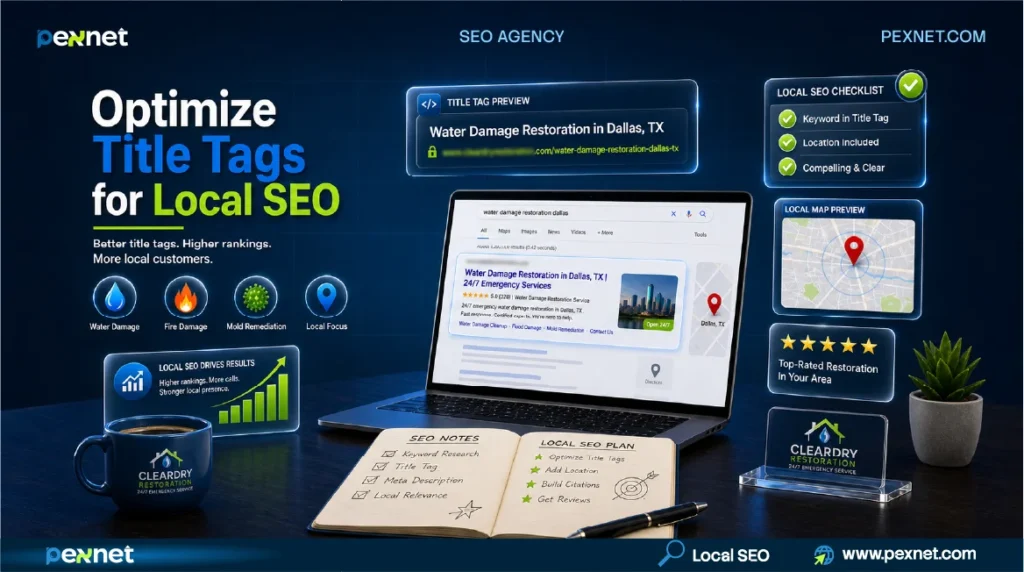
Did you know your small business may lose valuable jobs just because your title tags aren’t optimized? Yes, they are that much important.
Let’s say you have a restoration business named RestorePro. In that case, your page titles should quickly tell people what service you offer, which city you serve, and why they should choose you. This will also help Google better understand what every page is about.
We created this exclusive guide to help you learn how to optimize title tags for local SEO in 2026. For your convenience, we’ll use the example of a restoration website SEO throughout the blog.
30-Second Self-Diagnostic: Is Your Title Working?
Before comparing yourself to your competitors, let’s check your own site first.
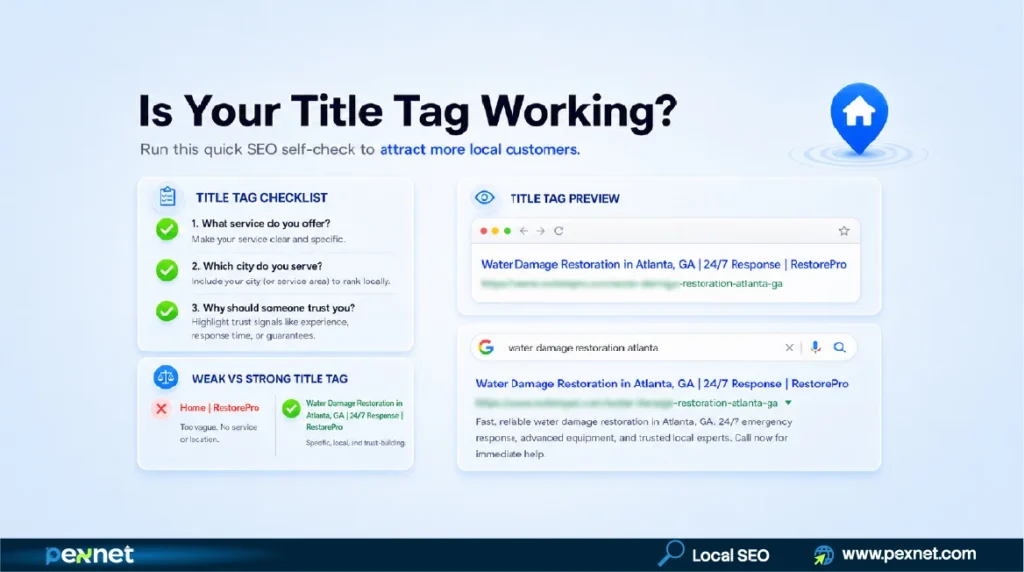
Open your website. Look at the small text at the very top of the browser tab. That’s your title tag. On Google, that same text usually becomes the blue clickable headline people see in search results.
Now, ask yourself this: From that title alone, can someone clearly understand what you do, where you work, and why they should trust you?
A strong restoration homepage title answers these three things immediately:
- What service do you offer?
- Which city do you serve?
- Why should someone call you instead of someone else?
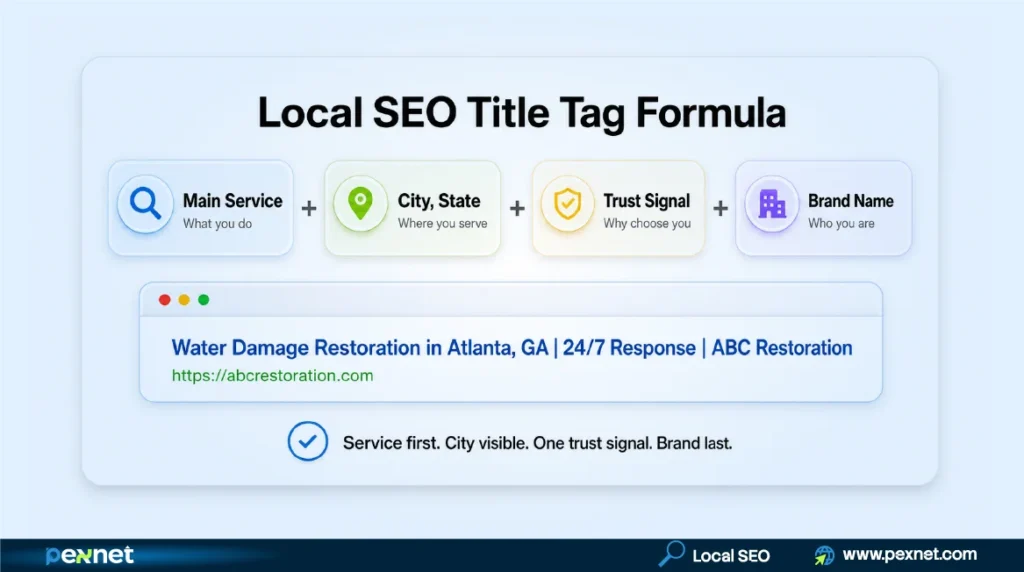
Here’s an effective formula:
[Main Service] in [City, State] | [Trust Signal] | [Brand Name]
Strong example: Water Damage Restoration in Atlanta, GA | 24/7 Response | ABC Restoration
Weak example: ABC Restoration — Home
The weak version tells Google nothing about your service or location. That means Google has no good reason to show your page when someone searches “water damage restoration Atlanta” or “fire damage cleanup near me.”
Titles to avoid:
- Home
- Welcome to ABC Restoration
- Professional Restoration Services
- Restoration Experts You Can Trust
They are either too vague or too brand-focused, and none of them connect your page to a local restoration search.
Quick mobile check:
Many restoration calls come from people standing in a flooded room, searching from their phone. If your title is too long, Google cuts it off. The service and city disappear, and so does the click.
Weak mobile title: ABC Restoration Company – Premier Water Damage Restoration and Emergency Cleanup Services in the Greater Atlanta Metro Area
Strong mobile title: Water Damage Restoration in Atlanta | 24/7 Help | ABC Restoration
The rule: Service first. City second. Trust signal third. Brand last.
How to Optimize Title Tags for Local SEO
Now, let’s talk business. Follow these steps and you won’t have to worry about local ranks anymore.
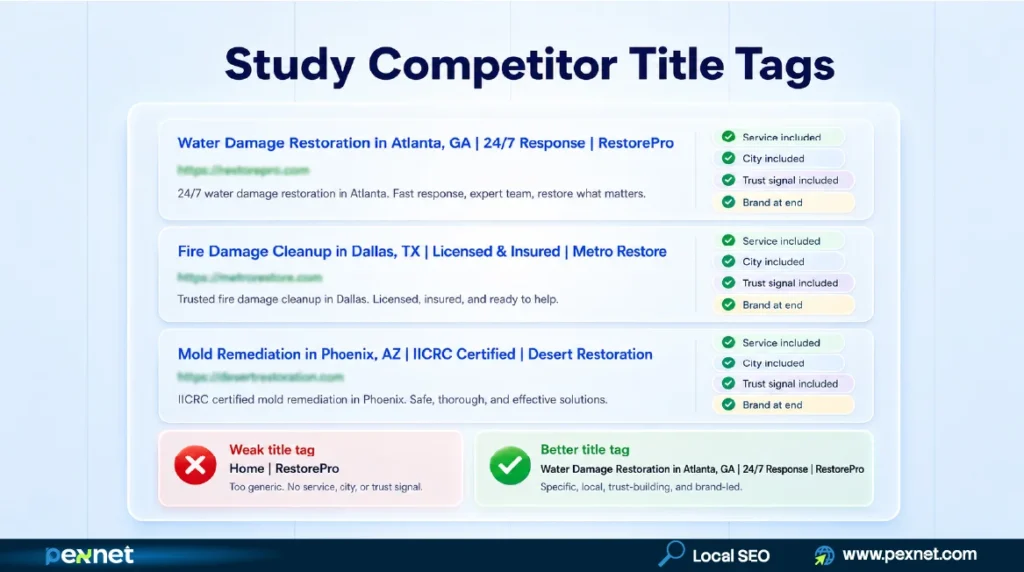
See How Your Top Competitors Write Their Titles
After checking your own titles, Google your main service and your city.
Examples:
- water damage restoration Atlanta
- fire damage cleanup Dallas
- mold remediation Phoenix
Look at the businesses already ranking on page one. Study their titles with these four questions:
- Do they mention the main service?
- Do they include the city name?
- Do they use trust words like 24/7, emergency, licensed, insured, or IICRC Certified?
- Is the brand placed at the end rather than the beginning?
Here, you’re using them as a benchmark to understand what Google is already rewarding in your specific market.
Also, check your own service pages the same way. Open your water damage page, mold page, fire page, and storm page one by one. Check to see if each has its own unique title targeting that specific service.
Wrong: Same title on every page: ABC Restoration | Professional Services | Atlanta
Right: Each page has its own specific title:
- Water Damage Page: Water Damage Restoration in Atlanta, GA | 24/7 Help | RestorePro
- Mold Page: Mold Remediation in Atlanta, GA | Safe Mold Removal | RestorePro
- Fire Page: Fire Damage Restoration in Atlanta, GA | Emergency Cleanup | RestorePro
Remember, duplicate titles on service pages make your website look poorly structured to Google. This is a serious issue you should be aware of.
Match Your Titles to How People Search
Your clients aren’t all searching the same way. Since they’re in three completely different mindsets, each one needs a different page with a different title strategy.
Emergency Mode
This includes searches like: “water in basement help,” “flood cleanup near me,” or “urgent fire damage clean up.”
These people are panicking, Googling mostly on mobile, and deciding in seconds. Your title must lead with urgency.
Emergency Water Damage Restoration in Atlanta | Call Now 24/7
Keywords: Emergency, 24/7, Now, Fast, Same-Day
Insurance Mode
Searches like: “water damage restoration insurance approved” or “IICRC certified mold remediation Atlanta.”
They have already filed a claim. They’re looking for a company that handles direct billing and works with adjusters.
Water Damage Restoration for Insurance Claims in Atlanta | Direct Billing
Keywords: Insurance Approved, Direct Billing, Works With All Insurers
Planning Mode
In this mode, you’ll see searches like: “how to find a good water damage company” or “average mold remediation cost.”
They are researching before any disaster hits (lower urgency, higher trust-building). These searches are best served by blog posts, not service pages.
What to Do in the First 24 Hours After Water Damage | RestorePro
Note: Roughly 60% of the searches driving calls to your business are not simple (service) in (city) queries. They’re emergency searches, insurance searches, or research searches.
If every page on your site uses the exact same title structure, you’ll be missing the majority of real customer intent.
Copy Paste Title Templates for Every Page Type
Replace the bracketed placeholders with your service, city, and brand. Hand this list directly to your web developer or whoever manages your site.
Homepage
[Top 1–2 Services] in [City, State] | [Trust Signal] | [Brand] Example: Water & Fire Damage Restoration in Atlanta, GA | 24/7 Response | RestorePro
If water restoration is 80% of your revenue, lead with water alone. If you do water, fire, and mold roughly equally, use the top two.
Service Pages (one service per page – never combined)
| Service | Example Title |
| Water Damage | Water Damage Restoration in Atlanta |
| Fire & Smoke | Fire & Smoke Damage Restoration in Atlanta |
| Mold | Mold Remediation in Atlanta, GA |
| Biohazard | Biohazard & Trauma Cleanup in Atlanta |
| Storm | Storm & Wind Damage Restoration in Atlanta |
| Sewage | Sewage Cleanup & Sanitization in Atlanta |
City Pages
[Service] in [Specific City] | [Brand] Example: Fire Damage Restoration in Decatur, GA | RestorePro
Emergency / “Near Me” Pages
Emergency [Service] Near You in [City] | [Trust Signal] Example: Emergency Water Damage Restoration Near You in Atlanta | 24/7
Insurance & Commercial Pages
Water Damage Restoration for Insurance Claims in Atlanta | Direct Billing Commercial Fire Damage Restoration in Atlanta | 24/7 Business Response Property Manager Water Damage Services | Atlanta, GA | RestorePro
Blogs
[Compelling Question or Headline] | [Brand] Example: What to Do in the First 24 Hours After Water Damage | RestorePro
Blog titles shouldn’t follow the location formula since they target informational searches. In this case, question-style headlines consistently outperform statement headlines for blog content.
Contact Page
Contact [Brand] in [City] | [Conversion Signal] Example: Contact RestorePro in Atlanta | 24/7 Emergency Hotline
If you’ve a common “Contact Us” title, you’re wasting one of the highest-intent pages on your site. Someone landing on your contact page is ready to call, so your title should confirm they’re in the right place.
How to Improve Your Calls & Rankings
Once you’ve completed the diagnostic, don’t rewrite everything randomly. Fix the biggest problems first in this order:
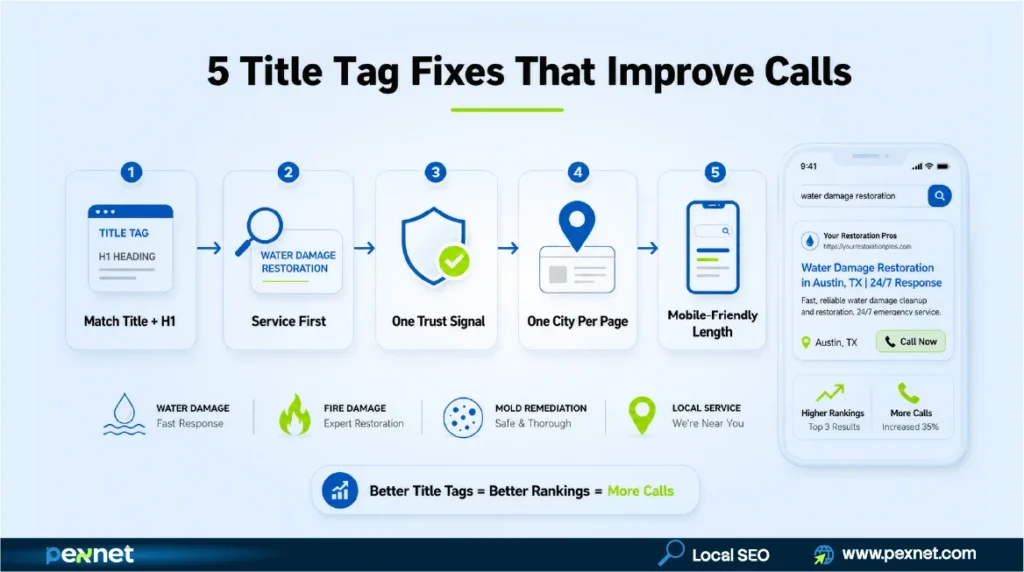
Fix 1: Make Your Title and Main Page Heading Match
Your title tag (in the browser tab) and your H1 (the main visible heading on the page) should talk about the same service and city. They don’t need to be word-for-word identical, but they shouldn’t contradict each other.
Clear and Consistent:
- Title: Water Damage Restoration in Atlanta | 24/7 Response | RestorePro
- H1: Water Damage Restoration in Atlanta
Confusing:
- Title: Water Damage Restoration in Atlanta | 24/7 Response | RestorePro
- H1: Welcome to RestorePro
The second version makes Google uncertain what the page is about. Fix the H1 to include the service and city so Google’s confidence in your page goes up immediately.
Fix 2: Put the Service First, Brand Last
Look at the titles already ranking in your market. Strong local restoration titles lead with the service, not the company name.
Weak Order: RestorePro – Water Damage Restoration in Atlanta
Strong Order: Water Damage Restoration in Atlanta | 24/7 Response | RestorePro
This order works because those searching during an emergency don’t know your brand yet. They know they need water damage cleanup. So, lead with what they’re searching for – not who you are.
Note: Here’s an exception – if you’re already popular and many people already search your brand name directly, you can lead with the brand on your homepage. But always put the service first on service pages and city pages.
Fix 3: Add Only One Clear Trust Signal
A trust signal is a short phrase that gives people one more reason to click. For restoration companies, the most effective ones are:
- 24/7 Emergency Response
- Licensed & Insured
- IICRC Certified
- Insurance Approved
- Free Damage Assessment
Don’t try to stuff several trust signals into one title.
Overcrowded and Ineffective: Water Damage Restoration in Atlanta | 24/7 IICRC Certified Licensed Insured Free Estimate | RestorePro
Google will cut this off because the message becomes noise.
Clean and Clickable: Water Damage Restoration in Atlanta | 24/7 Response | RestorePro
How to Choose the Right One:
- Emergency water and fire pages – 24/7 Response
- Mold pages – IICRC Certified or Licensed & Insured
- Insurance-related pages – Insurance Approved or Direct Billing
One trust signal per title and make it the one that matters most to the customer on that page.
Fix 4: One City Per Page Title
We’ve seen that some restoration websites try to target more than one city in a single title. This looks like keyword stuffing and makes the title too long to rank or display properly.
Wrong: Keyword Stuffing – Water Damage Restoration in Atlanta, Marietta, Decatur, Roswell & Sandy Springs | RestorePro
Right: One Focused City Page per Location
- /atlanta/ → Water Damage Restoration in Atlanta, GA | 24/7 Response | RestorePro
- /marietta/ → Water Damage Restoration in Marietta, GA | 24/7 Response | RestorePro
- /decatur/ → Water Damage Restoration in Decatur, GA | 24/7 Response | RestorePro
Each city page gets its own title, H1, and local content. Based on experience, we’re confident that this focused structure ranks far better than one overloaded page trying to target every city at once.
Fix 5: Keep It Short Enough for Mobile Users
After rewriting your title, test it on your phone. Google your business name and look at how the title appears in results.
Too Long that Gets Cut Off: RestorePro – Premier Water Damage Restoration Services in the Greater Atlanta Metro Area | 24/7 Emergency
Mobile-Optimized: Water Damage Restoration in Atlanta | 24/7 | RestorePro
Target 50–55 characters, or under 540 pixels wide.
Note: Google measures pixel width, not character count. That’s why wide letters like W and M eat more space. If anything gets cut, let it be the brand. The service and city should stay visible.
Why 2026 Is Different & Why Old Titles May Be Hurting You Now
Things have changed between late 2025 and early 2026 after some Google core updates. As a result, titles that were acceptable in 2023 are now actively working against restoration sites.
You’ve to consider AI’s impact on search behavior now when learning how to optimize title tags for local SEO.
Google Now Rewrites 76% of Title Tags
That’s up from roughly 60% in earlier studies.
The most common triggers for rewriting are:
- Titles that don’t match the H1
- Generic phrasing like “Our Services”
- All-caps formatting
- Brackets in the title
- Titles that promise more than the page delivers
Once Google rewrites your title, you obviously lose control of how your business appears in search results. We recommend that you match your H1 to your title so rewrites drop dramatically.
The March 2026 Core Update Penalized Title-Page Mismatches
If your title says “#1 Water Damage Restoration in Atlanta” but the page behind it is three thin paragraphs, the update treats that as a quality problem. Your title should always accurately reflect what the page delivers.
AI Search Now Uses Title Tags as a Primary Citation Signal
When a homeowner asks ChatGPT, Gemini, or Perplexity “who’s a good water damage company in Atlanta?,” your title tag is one of the first things the AI evaluates to decide whether to cite your business.
AI Overviews now appear on roughly 25% of relevant local searches. The businesses being cited there are pulling traffic that used to go to the #1 organic result.
Rules for AI visibility:
- Be specific: not “#1 Best Ever.” AI systems ignore superlatives.
- Match conversational queries: question-format content in blogs and FAQs usually gets cited more frequently.
- Avoid clickbait: AI filters filter exaggerated claims and hyperbolic language.
If a vendor sold you a title package in 2023 or 2024 and you haven’t audited since, that work is probably hurting you now. Remember, rewrites that worked then can trigger penalties today.
Ship These Three Fixes First (If You Have One Hour)
You don’t need to fix everything today. These three changes will deliver measurable results in 4–6 weeks.
Fix 1: Rewrite Your Homepage Title (15 Minutes)
Use the formula: Service + City + One Trust Signal + Brand. Make sure it matches your H1.
Fix 2: Fix Your Highest-Traffic Service Page (15 Minutes)
Open Google Search Console. Find which service page gets the most impressions. Rewrite its title using the service page template above.
Fix 3: Test Both on Mobile (15 Minutes)
Search Google for your business on your phone. Confirm both titles display fully without being cut off. If anything’s truncated, shorten until the service and city are fully visible.
Bonus Fix: (Spy on the #1 Competitor in Your Market)
Find the restoration company ranking #1 for “water damage [your city].”
Right-click their page → View Page Source → search for <title>.
Read how they’ve written their title. Check three of their service pages.
If they’re using the same generic title across all pages, that’s your opening. Write more specific, intent-matched titles to take the edge.
FAQs

Riadul Islam
Riad is a Senior SEO Consult who lives and breathes all things SEO. With 11 years of SEO experience under his belt, he’s now deeply involved in applying AI search technology and data science into niche-specific SEO. He’s an active member of top SEO forums to keep his strategic thinking, problem-solving, and creativity supercharged.