Local SEO for Law Firm: Your DIY Guide to Rank in 2026
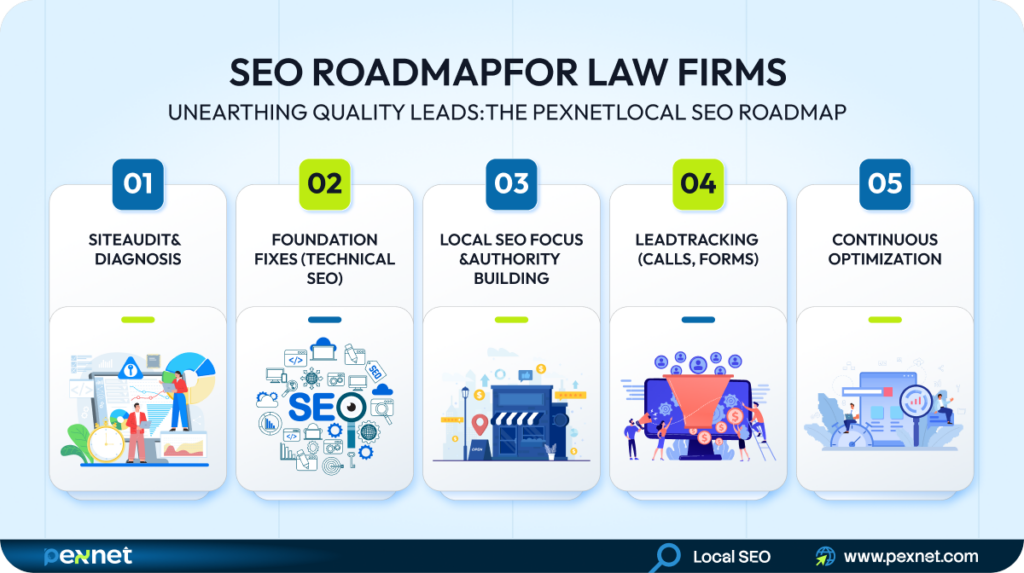
When someone types “personal injury lawyer near me” or “divorce attorney in (your city),” they’re ready to make a call. The only question is whether your firm shows up before your competitors do.
This step-by-step guide covers everything you need to know about local SEO for law firms, from setting up your Google Business Profile the right way, to building the kind of website and content strategy that puts you in front of clients.
Why Local SEO for Law Firms Is Different
Before jumping into the steps, let’s discuss why law firm SEO isn’t the same as local SEO for a restaurant or a plumber.
Legal Content is YMYL
Google classifies legal services as “Your Money or Your Life” content, i.e., searches where bad information could seriously harm someone.
That means Google holds law firm websites to a higher standard of trust, accuracy, and expertise than most other industries. As a result, you can’t just publish thin content and expect to rank.
You’re Bound by Bar Advertising Rules
Most state bar associations have strict rules about what attorneys can claim in advertising, such as no misleading statements, limited use of testimonials, and restrictions on comparative claims.
Your Service Area Is Restricted by Licensure
Unlike a moving company or carpet cleaner who can choose any market, you can only practice in states where you’re licensed. That makes geographic targeting precise and non-negotiable.
The Competition Is Intense
Legal is one of the most competitive local search markets in the world. Personal injury, DUI, and family law are high-value practice areas where law firms spend aggressively on SEO and ads. Getting this right matters more than it does in most industries.
How to Do Local SEO for Law Firms
Add these steps to your strategy, and you’re good to go:
Step 1: Optimize Your Google Business Profile
Your Google Business Profile (GBP) pushes your appearance in the Local Pack – the map with three law firm listings that appears at the top of local search results before any organic results.
Did you know fully completed GBPs rank 42% higher than incomplete ones?
Here’s what to do:
Claim and verify your listing:
If you haven’t claimed your GBP yet, do it today at business.google.com. Google verifies by mailing a postcard to your office address. The whole process usually takes 7-14 days.
Choose your categories carefully
Your primary category should be specific: “Personal Injury Attorney,” “Criminal Defense Attorney,” “Family Law Attorney,” or whatever your main practice area is. Add secondary categories for other services you actively take cases in.
Write a keyword-rich business description
Your description can be up to 750 characters. Mention your primary practice areas, your city, and what makes your firm different, without making claims your bar association prohibits.
Complete every section:
- All services listed with individual descriptions
- Accurate office hours (update for holidays)
- Phone number, website link, and appointment booking URL
- Accepted payment methods and consultation availability
- Language services if applicable
Add the right photos
Upload photos of your office exterior, reception area, conference room, and team. Remember, add only real photos, not stock images.
Firms with photos get 42% more requests for directions and 35% more click-throughs to their website.
Post weekly
Google Posts keep your profile active and visible. Share personal legal tips, case results (within bar rules), community events, or team announcements.
One post per week works for most law firms.
Step 2: Build Your Local Pack vs Organic Strategy
The Local Pack and organic search results are two different ranking systems, and you need both.
| Local Pack (Map Results) | Organic Results | |
| Primary signal | Google Business Profile | Website content quality |
| Location impact | Proximity to searcher | City/state keywords on page |
| Reviews | Direct ranking factor | Indirect trust signal |
| Key asset | GBP completeness + citations | Practice area pages + backlinks |
| Timeline | 60–90 days | 4–9 months |
The Local Pack is driven by your GBP, reviews, citations, and how close your office is to the person searching. In fact, it’s the fastest way to show up for “near me” searches and generates the highest-intent clicks.
On the other hand, organic results are driven by your website, the quality of your content, your page structure, and the authority your site has built through backlinks. They take longer but generate sustained traffic across dozens of keywords.
So, a smart law firm local SEO strategy builds both simultaneously. Don’t focus exclusively on one while ignoring the other.
Step 3: Nail Your NAP Consistency
NAP stands for Name, Address, Phone number, and every instance of these three details all over the web must be identical.
This means your firm name, address format, and phone number need to match exactly on:
- Your website
- Google Business Profile
- Every legal directory
- Yelp, Facebook, Apple Maps, Bing Places
- Your local Chamber of Commerce listing
- Any other place your firm appears online
Why is it important? Because Google gets confused even with small differences like “Suite 100” vs. “Ste. 100.”
Run a quick audit: Google your firm’s name and check the first 10 results. Fix every inconsistency you find before doing anything else.
Step 4: Get Listed on Legal Directories
You should know that legal-specific directories usually have more ranking authority for law firms than general business directories. This is because Google recognizes them as authoritative, industry-relevant sources.
Here are the directories to prioritize:
- Legal-specific (highest priority):
- Avvo
- Justia
- FindLaw
- Lawyers.com
- Martindale-Hubbell
- Your state bar association directory
- Your county or local bar association
- General local directories:
- Google Business Profile (already covered in Step 1)
- Bing Places
- Apple Maps
- Yelp
- Better Business Bureau
- Local Chamber of Commerce
Each listing should have the same NAP information and it should link back to your website. In case you didn’t know, these listings are called citations.
Step 5: Build Dedicated Practice Area Pages
Putting all your services on a single page means you’re trying to rank one page for “personal injury,” “DUI defense,” “family law,” “estate planning,” and more all at once.
Every major practice area needs its own dedicated page. Otherwise, you’re burning your own bridges.
An effective practice area page includes:
- A title tag and H1 that includes the practice area and your city (e.g., “Personal Injury Attorney in Chicago, IL”)
- A clear explanation of the legal process and what clients can expect
- Local context; i.e., mention the courts where you practice, local statutes, or jurisdiction-specific timelines
- An FAQ section addressing the common questions clients search for
- Clear CTAs, phone number, contact forms, or consultation booking buttons
Some examples of practice area pages a law firm should have are:
- Personal Injury Attorney in (City)
- Criminal Defense Lawyer in (City)
- DUI Attorney in (City)
- Family Law Attorney in (City)
- Divorce Lawyer in (City)
- Estate Planning Attorney in (City)
- Workers Compensation Lawyer in (City)
Step 6: Build Attorney Bio Pages
Since your attorney bio pages are a powerful SEO tool, don’t treat them as an afterthought.
Google’s YMYL framework means it wants to see verified, credentialed humans behind legal content. Attorney bio pages directly address this by showing:
- The attorney’s full name, credentials, and bar admissions
- Law school, year admitted to the bar, and years of practice
- Practice areas and notable case experience
- Professional memberships (state bar, local bar, specialty associations)
- Real, professional photos (not stock)
From an SEO standpoint, each attorney bio page helps:
- Build E-E-A-T signals (Experience, Expertise, Authoritativeness, Trustworthiness)
- Create opportunities to rank for “(Attorney Name) lawyer (City)” searches
- Add credibility signals that help your whole domain rank better
Link your bio pages to the relevant practice area pages, and link your practice area pages back to the relevant attorney bios. This internal linking structure informs Google of exactly who handles what for better clarity.
Step 7: Build a Bar-Compliant Review Strategy
Law firms with 50+ Google reviews get 71% more clicks from local search results. But reviews in the legal industry come with rules.
Most state bar associations prohibit:
- Paying clients for reviews
- Offering discounts or gifts in exchange for reviews
- Using testimonials that imply guaranteed results
Here’s a compliant review strategy that works:
Ask every satisfied client directly
The best time to ask is immediately after a successful outcome, while the experience is fresh.
Keep this in mind: a simple, direct ask (“Would you mind leaving us a Google review? It really helps other people find us.”) works better than automated text campaigns.
Make it easy
Create a direct link to your Google review page and include it in your post-case follow-up email. The fewer clicks between the ask and the review, the more completions you’ll get.
Respond to every review
Here’s the rule of thumb: positive and negative, respond within 48 hours.
Your response to a negative review is more important than the review itself. It shows how you handle adversity, which matters a lot when prospects are deciding who to trust.
Focus on review velocity, not just volume
Consistent new reviews every month means your firm is active and trusted, more so than a one-time burst of 40 reviews followed by nothing.
Step 8: Optimize Your Website for Local Search
Your GBP gets people to your listing, while your website closes the deal. It also needs to be optimized to take your place on the map pack.
Page Titles and Meta Descriptions
Every page needs a unique title that includes the practice area and your city. For example: “DUI Attorney in Atlanta, GA | (Firm Name).”
H1 Headings with Location
Your homepage H1 should include your city: “Trusted Personal Injury Attorneys in (City, State).” Service pages should follow the same rule.
Location in the URL
Clean, descriptive URLs help: /personal-injury-attorney-dallas-tx/ performs better than /services/page3/.
Embed Google Maps
Add a Google Maps embed to your Contact page and any location-specific pages. It strengthens your geographic presence and helps users find you.
Optimize for Mobile
Your site needs to load fast, display cleanly on a phone, and make it easy to call or contact you in seconds. Run your site through Google PageSpeed Insights, anything under 70 on mobile needs attention.
Add Schema Markup
Use LegalService and Attorney schema on your practice area and bio pages, and FAQPage schema on any page with a FAQ section. Schema markup helps Google understand your content better.
Step 9: Create Local Content That Builds Authority
You don’t want a casual browser. Your target should be showing up when people are researching their legal situation before deciding who to call.
The best topics are the questions your intake team hears every week:
- “How long does a personal injury case take in (State)?”
- “What happens if you get a DUI in (City)?”
- “How is property divided in a divorce in (State)?”
- “What should I do if I’m injured at work in (City)?”
Write One Post per Question
Answer it thoroughly, accurately, and with local context. Also, mention your state’s specific laws, local courts, or jurisdiction-specific timelines.
Location Pages for Multi-City Firms
If your firm serves a few cities, each one needs its own location page, not a copy-paste template. Each page should include unique content specific to that area: local court information, area-specific legal considerations, and a clear call to action with the local phone number.
Step 10: Build Local Backlinks Through Legal PR
Try to get links from legal authority sources in your area and the local press.
Here’s how to build them:
Local News and Press Mentions
Reporters covering legal stories regularly need expert commentary.
Reach out to local journalists covering courts, crime, family issues, or business disputes and offer to be a quoted source. A single local news mention with a link to your firm’s website works like a charm.
Bar Association Publications
Submit articles or case analyses to your state or local bar association’s publication. These links are highly relevant and authoritative.
Continuing Legal Education (CLE) Providers
They are niche-relevant, authoritative links. If you’re a speaker at a CLE event, the organizer might link to your bio.
Community Legal Clinics
Hosting or participating in a free legal clinic generates press coverage, event listings, and local community links – all of which helps strengthen your local authority.
Chamber of Commerce and Local Business Groups
Join your local Chamber if you haven’t already. The backlink from their member directory is one of the easiest high-quality local links available to any firm.
Quick-Check: Where Does Your Firm Stand?
| Area | What to Check |
| Google Business Profile | Fully completed? Weekly posts? Reviews flowing in monthly? |
| NAP Consistency | Identical name, address, phone across every listing? |
| Legal Directories | Listed on Avvo, Justia, FindLaw, state bar, local bar? |
| Practice Area Pages | One dedicated page per major service? City in title and H1? |
| Attorney Bio Pages | Each attorney has a full, credentialed bio page? |
| Reviews | 50+ Google reviews? Responding to all of them? |
| Website Technical | Mobile-friendly? Loads in under 3 seconds? Schema installed? |
| Local Content | Blog covering questions clients actually search for? |
| Local Backlinks | Cited in local press, bar publications, or community events? |
If you checked “no” on four or more, your firm has real gaps that are costing you cases right now.
FAQs
How long does local SEO take for a law firm?
Ans. Law firms usually start seeing positive movements in 3-6 months. But competitive practice areas in large markets, such as personal injury, DUI, family law could take 6–12 months to build strong Local Pack and organic positions.
Do I need a separate page for each city I serve?
Ans. Yes, of course. A generic “We serve the tri-state area” mention on your homepage won’t rank you anywhere. Each city needs dedicated, quality content.
Can solo practitioners compete with large law firms in local search?
Ans. Yes, that’s very much possible. Larger firms may overlook hyper-local neighborhoods and niche practice area keywords. So, solo and small firm attorneys have the opportunity to outrank big firms in specific suburbs and for specific search terms because they can move faster and target more precisely.
Should I hire an SEO agency or do this myself for local SEO for law firm?
Ans. You can follow some primary steps in this guide. But you’ll need professional help for competitive markets, multi-location firms, technical SEO, and link building.
What legal directories matter most?
Ans. In order of priority: your state bar directory, Avvo, Justia, FindLaw, and Martindale-Hubbell. They carry the most authority for law firm SEO and should be claimed and fully completed before anything else.

Riadul Islam
Riad is a Senior SEO Consult who lives and breathes all things SEO. With 11 years of SEO experience under his belt, he’s now deeply involved in applying AI search technology and data science into niche-specific SEO. He’s an active member of top SEO forums to keep his strategic thinking, problem-solving, and creativity supercharged.