Carpet Cleaning Email Marketing Guide: Stop Losing Jobs
Carpet Cleaning SEO
July 2, 2026
Last updated: July 29, 2026
The carpet cleaning industry demands a professional deep cleaning every 12 to 18 months. So every cleaning session comes with a date when that customer will need you again. The question is whether your name is in their inbox when that date arrives or a competitor’s ad is.
That’s the job email does for a carpet cleaning business. It doesn’t find new customers. It makes sure the ones you already paid to retain come back. Let’s discuss what works for carpet cleaning email marketing and how to prove it’s paying off.
Why Most Carpet Cleaners Get Zero Return from Email
Here’s what we actually find when we audit carpet cleaning companies. When Atlanta Carpet Cleaning came to us in January 2023, they had no review generation strategy in place. When we audited D.A. Burns & Sons in Seattle, a company that has been cleaning carpets since 1935, we flagged the lack of a systematic review-request process as a major issue, and their review responses were slow and inconsistent.
In both cases the gap sat in the same place: what happens after the truck leaves the driveway. That’s the gap email fills.
Without a quality email list, customer segmentation, and consistent follow-up, even the best promotions will struggle to generate bookings. That’s why a strategic approach is essential if you want email to become a reliable source of repeat customers.
Top 7 Email Marketing Strategies for a Carpet Cleaning Business
Successful email marketing is about sending the right emails to the right people at the right time. The following strategies can help you stay connected with your carpet cleaning customers, increase repeat bookings, and generate more revenue without relying entirely on paid advertising.

1. Collect emails first
Before you can benefit from email marketing, you need a reliable way to collect customer email addresses. Every touchpoint should be an opportunity to grow your email list, including:
- Contact forms on your website
- Online booking pages
- Quote requests from the clients
- Follow-up communications.
- GBP appointments
- Contact from socials
Most of your bookings won’t come through a web form at all. For Atlanta Carpet Cleaning, monthly calls from search went from 4 to 120 between January 2023 and March 2024. Those callers never typed an email address into anything.
From what we’ve seen across our carpet cleaning clients, the booking confirmation page is the single highest-converting email capture point, because the customer has already committed. Most cleaners skip it entirely and only collect the email in the invoice. Add an opt-in checkbox at booking (“Send me carpet care tips and cleaning reminders”), and you’ll build the list from every job without extra effort. That’s how your carpet cleaning SEO is connected with other marketing sales funnels.
2. Create your own email list
One thing we see regularly: carpet cleaners relying on Thumbtack, Angi, or HomeAdvisor for leads but never capturing those customers into their own list. The problem is that those platforms own the relationship. When you stop paying, the leads stop. Your own email list is the one channel nobody can take away from you.
Practically, this means every lead that comes through a third-party platform should end up in your CRM by the time the job is complete. We set this up for our Atlanta client by adding a simple post-booking step: the technician confirms the customer’s email at the door before starting the job. That single habit built a list of 200+ verified addresses in the first six months, all people who’d already used the service and could be reactivated later.
3. Group your customers by type
When we set up email for a carpet cleaning client, the first thing we build is the segment structure, because sending the same email to a homeowner and a property manager (each having their own needs) gets you unsubscribes from both. Here’s the five-group split we use:.
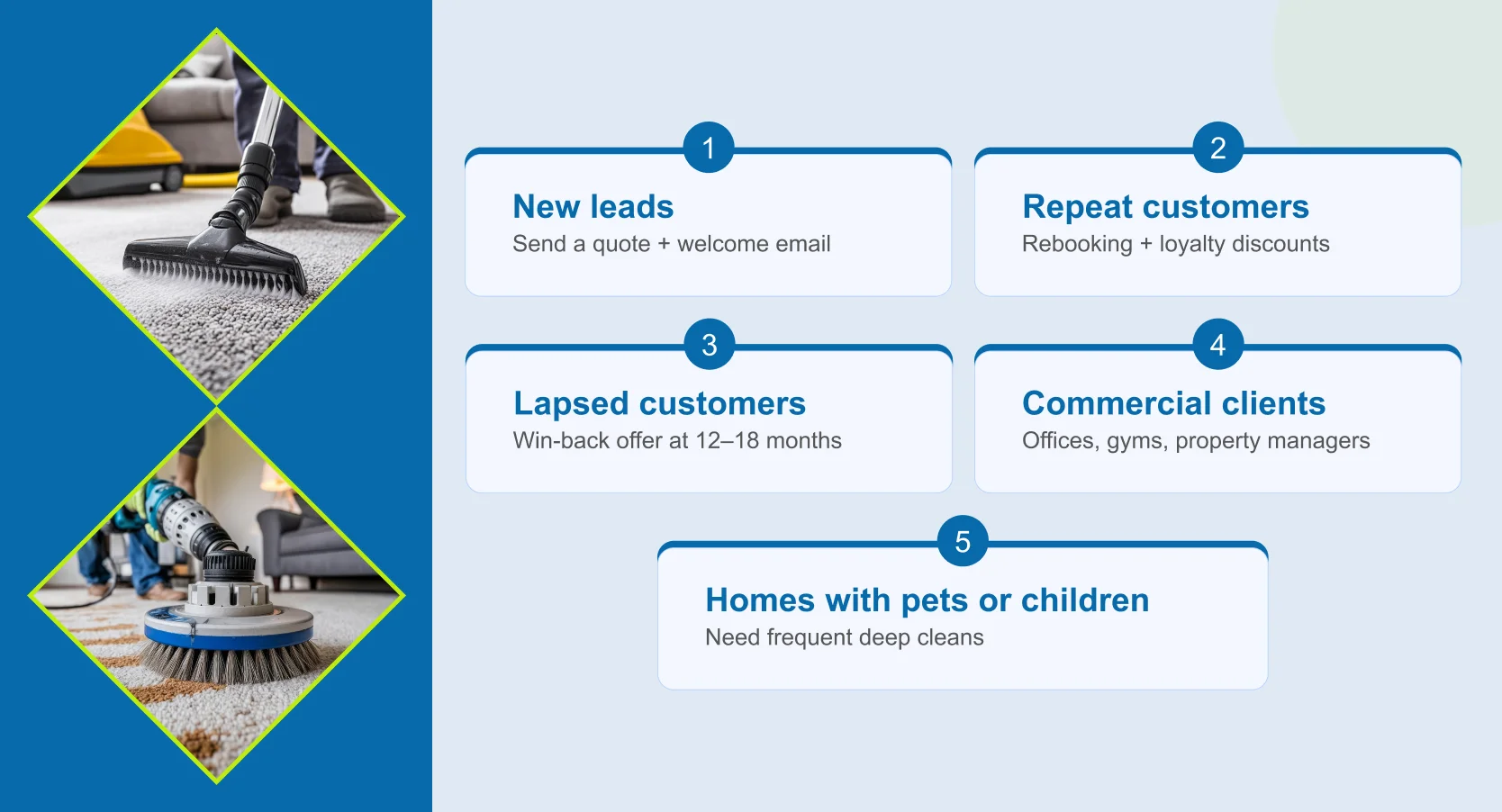
By segmenting your email list into meaningful groups, you can deliver more relevant content and offers. We usually suggest carpet cleaning businesses to segment their customers into the following 5 groups:
- New leads: Those who just asked for a quote or signed up, but have not taken any service yet. You can send them a quote, a welcome email, or other offers they might be interested in.
- Repeat customers: Customers who booked your services more than twice. Send them rebooking emails when necessary, with loyalty discounts.
- Lapsed (18+ months since last booking): They’ve passed the window the Carpet and Rug Institute recommends for professional cleaning, and for many carpets they’ve also passed the point where the manufacturer’s warranty expects it. These are your win-back targets.
- Commercial: Include commercial clients in this group. For example, corporate offices, gym, restaurants, and property managers. Although this is a highly profitable group, carpet cleaners often forget to make a distinct segment for the commercial clients.
- Homes with Pets or Children: Homes with pets and young children need deep cleaning frequently. So, it’s wise to create a different segment for them.
4. Use what you know about the customer
Every job you complete gives you data: what service was done, when, what type of property, and whether there are pets. We use that data to make each email feel like it was written for that person.
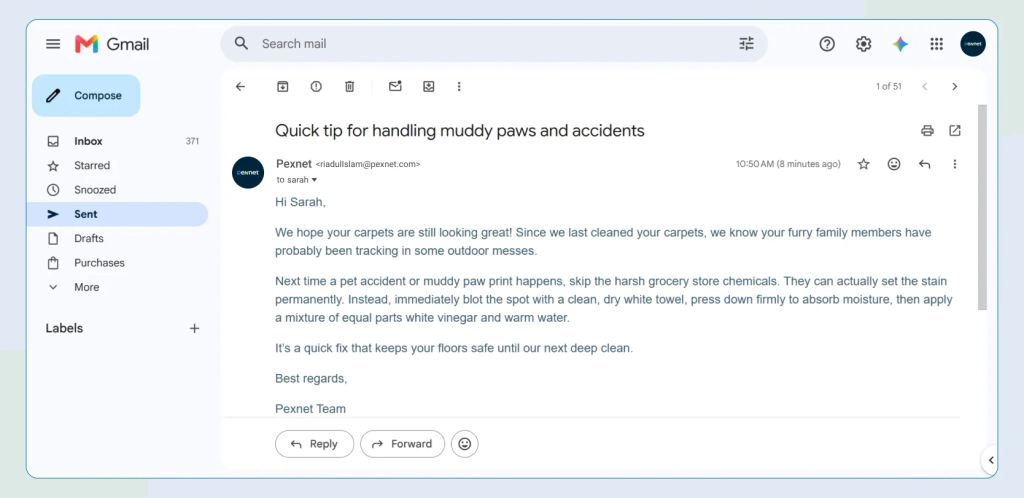
For example, here’s an email we sent to a pet-owning customer between cleanings. It costs nothing to send and keeps our client’s name in front of the customer weeks before the next booking window opens.
5. Give value, don’t just push discounts
One mistake we corrected early in our Atlanta client’s campaign: every email they had ever sent was a discount offer. Open rates were dropping month over month because subscribers had learned to ignore them. We switched to a 3:1 ratio (three value emails for every promotional one), and open rates recovered within two send cycles.
A better approach is to provide useful information alongside promotional offers. Share carpet maintenance tips, stain removal advice, seasonal cleaning recommendations, or answers to common customer questions (refer to the previous example).
When subscribers consistently find value in your emails, they are more likely to open future messages and remember your business when they need professional cleaning services.
The rule we follow for all our carpet cleaning clients: send 2 to 3 value emails (tips, seasonal advice, maintenance reminders) after every promotional send. It keeps unsubscribe rates low and makes the promotional emails perform better when they do land.
6. Automate it so it runs without you
The carpet cleaning owners we work with don’t have time to sit down and write emails every week, and they shouldn’t have to. The whole point of this setup is that once the sequences are built, they run on their own. Here’s what we use and why:
Automated email sequences allow you to stay in touch with customers without manually sending every message. There are several email automation tools that work by using predefined rules to send emails automatically based on user actions or a specific timeline.
We’ve tested several platforms with our carpet cleaning clients and settled on three based on what the business actually needs:
- Mailchimp for most small operators. Free plan covers up to 500 contacts, which is enough for a single-location cleaner in year one. Simple automation builder, good enough deliverability.
- ActiveCampaign when the client outgrows Mailchimp or needs CRM-style tagging. We moved our Atlanta client here once the list passed 400 contacts because the conditional logic (e.g. “if pet owner AND last service > 6 months, send this sequence”) is stronger.
- Smartlead only for outbound cold email to commercial prospects (offices, property managers). Not for your existing customer list.
The triggers we adjusted on day one: new booking completed (fires the welcome email), 1 day after service (fires the review request), 10 months after service (fires the rebooking reminder), and 18 months with no rebooking (fires the win-back).
7. Track jobs booked, not open rates
Don’t become distracted by marketing metrics such as open rates, click-through rates, and subscriber growth. These numbers can provide useful insights, but the ultimate goal of email marketing is to generate revenue and book more jobs.
So, instead of focusing exclusively on engagement metrics, track how many appointments each campaign generates. Measuring real business outcomes helps you identify which emails contribute to growth and which ones need improvement.
You can use different methods to measure a campaign’s performance:
- Tag your job booking links with UTM parameters
Before launching an email campaign, add UTM parameters to the links that direct customers to your booking or landing page. These tracking codes allow you to see exactly how much traffic and how many bookings each email generates.
- Connect your analytics to track the booking
Create custom links with tools like the Google Campaign URL Builder. Track your conversions by checking the Traffic Acquisition or Acquisition Reports in GA4.
- Use promo codes and dedicated landing pages
Using unique promo codes/coupon codes and dedicated landing pages for each campaign also lets you track your email performance.
The 5 Emails that Actually Book Repeat Jobs
The good news here is that you don’t need dozens of complicated email campaigns. In fact, carpet cleaning businesses can generate consistent repeat business with just a handful of emails.
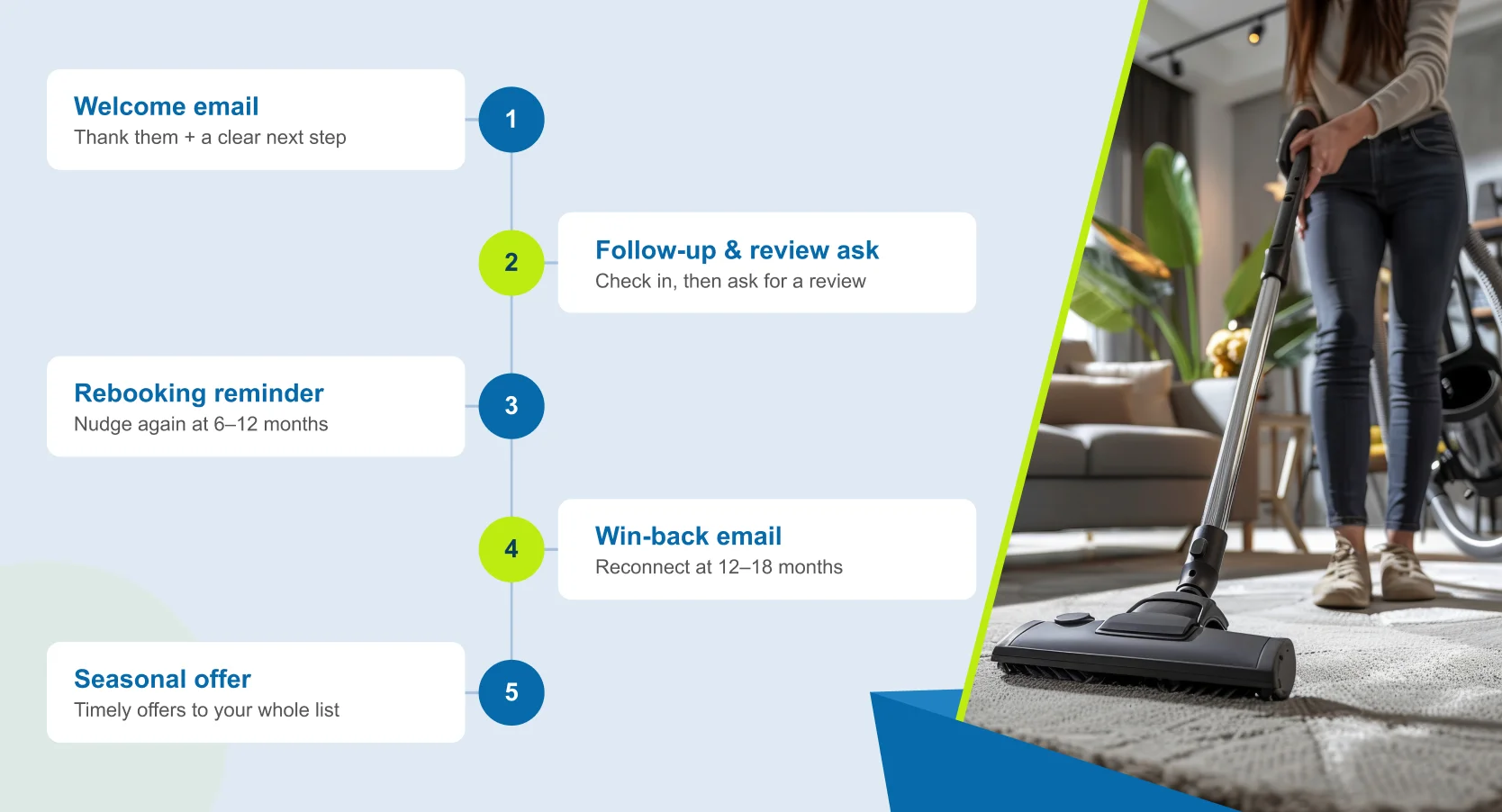
Here are the five emails every carpet cleaning business should have:
The welcome email
The first email sets the tone for your relationship with a customer. We keep it to four elements and nothing else:
- A thank you line with the customer’s first name and the service they booked.
- What happens next: when the technician arrives, what to expect, how long it takes.
- Your phone number and a “reply to this email” prompt in case they need to reschedule.
- One line about the business: how long you’ve been operating, how many jobs completed, your service area. Keep it to one sentence.
No discounts, no upsells, no links to social media. This email’s only job is to make the customer feel they chose a professional operation. The selling comes later.
The post-service follow-up and review ask
This one email did more for our Atlanta client’s growth than any other single tactic. Before we set it up, they averaged fewer than 2 new Google reviews per month. After, they were consistently getting 8 to 12. Here’s the structure we use, sent 24 hours after the job:
- Line 1 – satisfaction check: “Hi [first name], just checking that yesterday’s carpet cleaning met your expectations. If anything isn’t right, reply to this email and we’ll make it right.”
- Line 2 – the ask (only if they reply positively or don’t reply within 24 hours): “If you’re happy with the results, a quick Google review helps other homeowners in [city] find us. Here’s a direct link: [your Google review short link].”
Important: Google’s review policies prohibit offering incentives (discounts, gift cards, entries into a prize draw) in exchange for reviews. Don’t add “leave a review and get 10% off your next clean” as it violates Google’s contribution policy and risks getting reviews removed or your profile flagged. The ask alone, timed correctly, is enough.
We learned this the hard way: one of our early clients had been offering a $10 discount for reviews and lost 15 of them in a single policy sweep. A clean, no-incentive review request sent at the right time outperforms a bribed one every time.
The rebooking reminder (the one that makes money)
This is the single most profitable email a carpet cleaning company can send, and most cleaners don’t send it at all.
We set the trigger at 10 months after the last service, not 12. That gives the customer time to see the email, think about it, and book before they hit the 12-month mark when a competitor’s ad might catch them first. The email references the exact date of their last cleaning (“We last cleaned your carpets on [date]”), names the service performed, and ends with a one-tap booking link or a phone number. No coupon needed.
For our clients, this single automated email generates more repeat bookings than every other email combined. It works because the timing is specific to that customer and not a bulk send to all in list..
The win-back email
What happens when a customer hits the 12 or 18-month mark without rebooking? They are at risk of wandering over to a competitor. This is where the win-back email comes in.
Send a friendly email reminding them you’re still here. Keep the tone positive rather than pushy. A limited-time discount or a small bonus can help encourage them to give your business another try, but the message shouldn’t feel desperate.
A realistic benchmark from what we’ve seen: 5% to 10% of former clients will rebook from a single win-back email. On a list of 200, that’s 10 to 20 jobs recovered at zero acquisition cost. It won’t replace your SEO or ad spend, but it’s the highest-margin revenue you’ll earn all year.
The seasonal offer
The seasonal calendar we use for our carpet cleaning clients:
- March/April: Usually “Spring reset” where we target homes after mud season. Subject line that worked for us: “Your carpets survived winter. Here’s what’s hiding in them.”
- June, Pet, and Kid Focus: More foot traffic, messy art projects, and wet paws mean your carpets are about to take a beating this summer. Don’t let June’s chaotic fun turn into permanent stains.
- October, Pre-holiday refresh: “Guests are coming” angle. This is consistently the highest-converting seasonal send across our clients.
- January, Post-holiday deep clean: This targets wine stains, food spills, high foot traffic.
We send seasonal emails to the full list (not segment-filtered), but we personalise the subject line by segment. A pet owner gets “Holiday guests + your dog = time for a deep clean” while a commercial client gets “Get your office carpets guest-ready before the holiday rush.” Same campaign, different open rates..
Final Thoughts
When ChatGPT or Google AI Overviews recommend a local carpet cleaner, they prioritize businesses with high brand authority and direct customer engagement signals. Running a tight, responsive email list directly reinforces those trust metrics.
That’s why email marketing for carpet cleaning is so effective. A few well-timed emails can keep your business running smoothly, bring past customers back, and generate repeat jobs without increasing your ad spend
Email is one piece of the system. For the full picture of how the other channels (SEO, GBP, ads, reputation) fit together, see our carpet cleaning marketing guide. And if you want a second pair of eyes on your current setup, our carpet cleaning SEO team can audit your post-service workflow and tell you exactly what’s missing.
FAQs
Just make sure customers know they're signing up to receive emails from your business.
You can also send automated emails after a service, before it's time for another cleaning, or during seasonal promotions. The key is to stay in touch without overwhelming your subscribers.
A healthy mix of helpful content and promotions usually delivers the best results.

Md Riadul Islam
SEO Strategist & Carpet Cleaning SEO Specialist
Join 5,000+ design lovers.
Monthly design insights, case studies, & inspiration straight to your mail.
Share This Post




 100% Free
